Freemasonry's Secrets Have Been for Sale Since 1730
/Samuel Prichard printed the Masonic signs, words, and obligations in 1730, thirteen years after the first Grand Lodge formed. The lodges kept meeting.
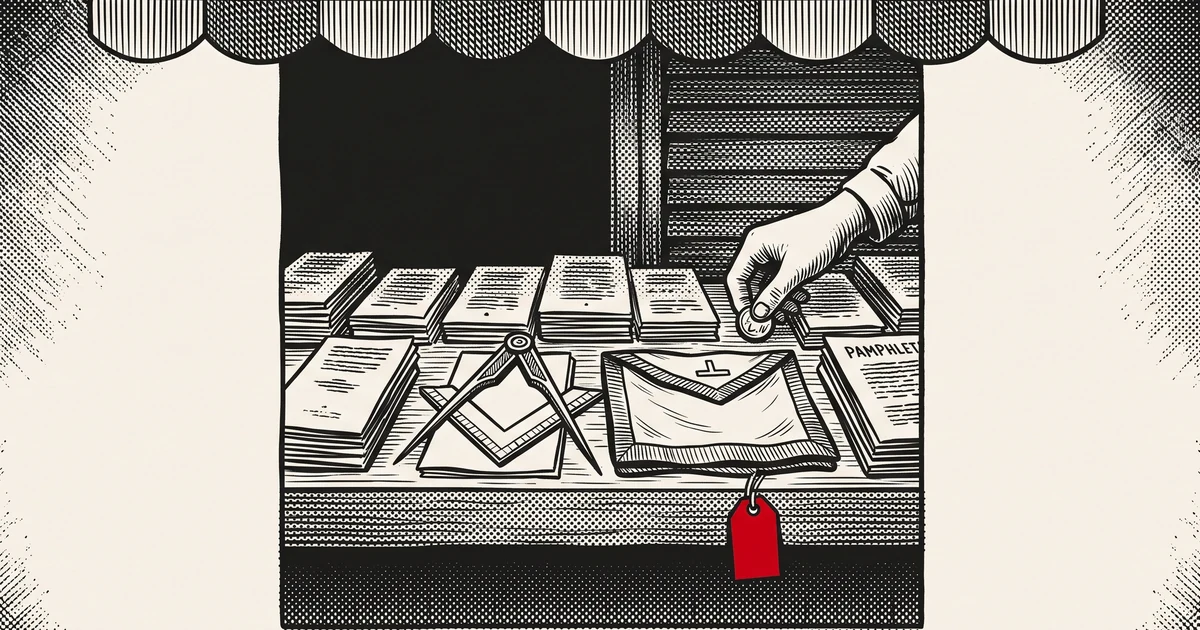
TL;DR: In October 1730 a London writer named Samuel Prichard printed the whole Masonic ritual and sold it over the counter. The lodges kept meeting anyway. I came at this one sideways, through a fight about pricing.
Freemasonry’s secrets have been purchasable since George II sat on the throne.
On October 20, 1730, Samuel Prichard published Masonry Dissected in London. Signs, passwords, the questions, the answers, the obligations, and the whole three-degree structure of initiation, including the Master Mason degree that had surfaced only a few years earlier.
England’s first Grand Lodge formed in 1717. The exposure arrived thirteen years later. The secrets were young enough to have acne.
I care about this for reasons that have nothing to do with aprons. I put my field guides on the site for free and price the paid ones at a couple bucks, and every few weeks somebody from the creator world explains to me that free reads as worthless, that if I hid the good part behind a three hundred dollar paywall people would finally want it.
That is horseshit with a three hundred year pedigree. Prichard ran the experiment already, and I’ve been arguing the same fight since the day I published the smallest thing I could sell.
Prichard sold the catechism word for word
A question gets asked. The initiate supplies the answer that belongs to it. Page after page of that, printed in a shape any coffeehouse reader could carry home in his head.
The book handed the public portable ritual data. How Masons recognized each other, the language attached to each degree, and the obligations meant to bind a member to silence.
That is why it traveled. Masonry Dissected was reprinted over and over and translated into German, Dutch, and French, and it became one of the most consequential early exposures of the fraternity because everybody downstream, critics and imitators and Masons themselves, had to answer for it.
An exposure this early leaves a nuisance behind. Buy the words for the price of a pamphlet and the fraternity has to explain what remains.
The Grand Lodge started checking the man at the door
Grand Lodge minutes from December 1730 show concern about impostors and a push to examine visitors more carefully. The response was procedural rather than legal.
Ritual changed over time on its own account. Signs, wording, sequence, and methods of recognition could all be varied, which meant printed exposure kicked off an arms race between fixed text and living performance.
A book hands you the answer. The lodge decides whether your answer counts.
Print freezes the words. A room full of men doesn’t have to hold still for it, and didn’t.
Private and unknown are different animals
Wedding vows are printed in a hundred places. Say them out loud in front of a preacher with your people watching and you have done a thing you can’t take back. Read them off a screen at midnight and you have read.
Military manuals are public. I’ve read the ones that lay out every step of a job in order and teach you nothing about whether the men beside you will do it when the day comes.
Masonic ritual works partly through controlled sequence and participation. Knowing a word appears somewhere in a degree buys you nothing among people who treat that degree as consequential.
Exposure can even reinforce the inside. Once distorted, partial, contextless versions are loose in the world, members gain one more reason to sort authentic transmission from printed imitation, and the secret relocates from the words to the claim of proper possession.
Secret was already a sales department in 1730
London’s print market ran on exposés and confessions and criminal lives and religious controversy and forbidden knowledge, and Prichard walked into that market with a fast-growing fraternity attached to sociability and patronage and status, and he sold the reading public a door they could open themselves. It moved.
A curious reader got to see the inside of a room he was never going to be invited into. An impostor could imagine using the material to pass.
Freemasonry fed on the same appetite that threatened it. The exposures enlarged the aura, and a boring club doesn’t generate an international market for stolen handshakes.
The pattern holds up. Leaked initiation footage doesn’t kill a modern group. It recruits the exact bastard who wants to know what happens after the clip cuts out.
The hidden sentence was only ever the turnstile. What the crowd wanted was the building on the other side of it. Which is why I rent the reach and own the readers instead of hoarding a password somebody already put in print in 1730.
Nobody at the door gives a damn whether you read the book. They care who walked you in, and that has been the deal since before the United States existed.
Which leaves me the part I can’t settle. If the entire ritual has been sitting in print for that long and men keep lining up to be walked through it in a room anyway, what exactly does the guru charging three hundred dollars for the PDF think he’s selling me?
Sources
- Wellcome Collection: Masonry Dissected
- Google Books: 1730 edition of Masonry Dissected
- Early Masonic Catechisms, including Prichard’s text
Frequently asked questions
When was Masonry Dissected published?
London, October 20, 1730.
What did the book reveal?
The three-degree system in question-and-answer form, covering recognition signs, words, obligations, and the Master Mason degree.
Did the exposure destroy Freemasonry?
No. Grand Lodge tightened how visitors got examined, ritual practice kept shifting underneath the printed version, and the book went on selling across Europe.
Comments are open to members. Sign up free →