Stop Borrowing the Old Gods
/K.M. Weiland argues that mythic fiction is not retelling. Harlan agrees, and then names the part her framing leaves out: a myth is not finished until somebody else uses it for something you did not intend.
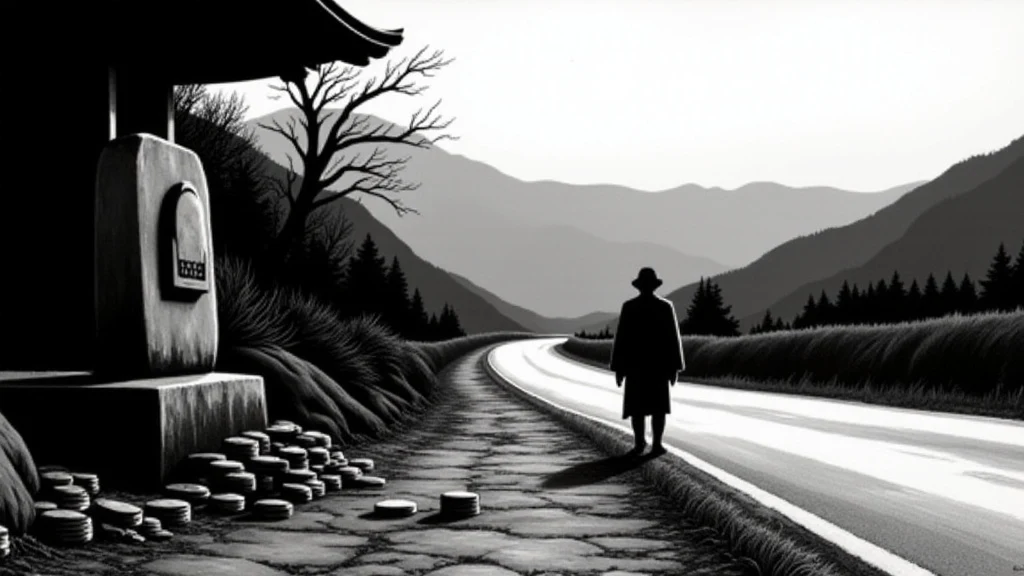
There is a shrine on a back road near where I grew up, and nobody can tell you who is in it. The carving wore smooth sometime before anyone currently living was born. People still leave things at the base of it. Coins, mostly, sometimes food, once a set of car keys that stayed there for a month.
That is a functioning myth. Nobody knows the story. The behavior survived the story, which means the behavior was never really about the story.
TL;DR: K.M. Weiland’s argument is that mythic fiction is not the retelling of old myths, it is participation in the ongoing act of making them. Her phrase for the failure mode is exact: “the cosplay of ancient characters.” She is right, and her second piece supplies the practices, intuition and dreamzoning and symbolism. What I want to add is the test she does not give you, which is the only one I have found that reliably tells you whether the thing you built is a myth or a costume.
What is she actually objecting to?
Weiland’s case is that our relationship to the old stories has gone thin in two directions at once. They have become “historical curiosities or commoditized junk food,” which is a fair description of the shelf. On one side, the annotated academic edition nobody reads for pleasure. On the other, the seventh novel this year about Persephone with the chapters alternating between her and Hades.
Her diagnosis of what writers do wrong is sharper than the complaint. She says we over-intellectualize the archetypes, reducing living myth to plot mechanics and character lists. That is the Hero’s Journey wall chart problem, and I have watched it hollow out more manuscripts than any other single piece of craft advice in circulation. A writer learns the beats, hits the beats, and produces something structurally identical to a myth and completely inert, the way a taxidermied wolf is structurally identical to a wolf.
Her positive claim is the one worth writing down: “the writer’s task is not simply to preserve mythology. It is to take part in it.”
And she is clear that the material is already in you rather than in a reference book. “The dream space from which story arises is inherently mythic,” she writes, and the instruction that follows is to trust your own symbolic authority instead of studying somebody else’s.
Where I would push
I write in a cosmology that is mostly invented. Demiurge, archons, the whole architecture. So I am the target audience for this argument and I am going to be difficult about it anyway.
Here is the problem with “make new myths”: Weiland’s own example list gives the game away. Star Wars, Lord of the Rings, The Matrix, Harry Potter, The Hunger Games, Wicked, Stranger Things, Fourth Wing. Every one of those is a work of authored fiction with a copyright date and an owner.
A myth does not have an owner. That is not a technicality, that is close to the definition. The old material got to be myth because it passed through enough hands that no hand is visible on it. Nobody signs the shrine on the back road.
So the honest version of her category is: fiction that behaves mythically for a while, inside a culture that will not actually let it complete the process, because the process requires the story to escape its author and our legal and commercial arrangements exist specifically to prevent that.
Which does not make the goal wrong. It makes it harder and stranger than “write from the dream space,” and I think a writer should know that going in.
The test
Weiland’s second piece supplies practices, and the ones she names, intuition, dreamzoning, symbolism, are the right materials. I use versions of all three. Dreamzoning in particular, the deliberate half-attentive drift where you hold an image and let it move on its own, is the single most productive hour in my working week and it looks exactly like doing nothing.
But materials are not a test, and here is the one I use.
Can somebody else use your symbol for a purpose you did not intend, without breaking it?
That is what separates a myth from an allegory. An allegory has a correct reading. You built it to mean a thing, and a reader who takes it somewhere else has misread it. A myth has no correct reading. It is a shape strong enough to hold whatever gets poured into it, which is why the same flood story serves as a warning about pride in one century and a story about grief in the next, and neither one is wrong.
Run your invented mythology through it. If a reader tells you what your central symbol meant to them and your instinct is to correct them, you built an allegory. If your instinct is that they found something true that you did not put there on purpose, you built something with myth in it.
The uncomfortable corollary: you cannot fully control what you made, and if you can, it is not the thing you were trying to make.
What the shrine actually teaches
The carving wore smooth and the offerings kept coming. Whatever specific god was in there stopped mattering, and the behavior it produced outlived every piece of content attached to it.
That is the direction of travel Weiland is pointing at, and it is worth being clear about the size of the ask. She is asking writers to build something that could, in principle, survive the loss of its own plot. Most fiction cannot. Most fiction is its plot, and there is nothing wrong with that, I have written plenty of it and will write more.
But when somebody asks why the weird fiction lane refuses to explain itself, this is the whole answer. An explained thing is finished. A finished thing is inert. The refusal to resolve is not a stylistic tic, it is the mechanism that keeps the shape open enough for somebody else to put something in it later.
Leave the face off the carving. Somebody will bring the coins.
Frequently asked questions
Is retelling an old myth always a mistake?
No, and Weiland is careful not to say that. Her objection is to retelling that mistakes borrowed authority for earned resonance, the version where using the names of Greek gods is expected to do the work that the writing has not done. A retelling that genuinely re-inhabits the material, that finds the part of it still live and presses on exactly that, is participation in the same tradition. The tell is whether the story would still function if you renamed everyone.
What is dreamzoning, practically?
It is deliberate unfocused attention on a story image, held long enough that the image starts moving without you steering it. In practice that means no notebook for the first stretch, no attempt to decide what anything means, and a willingness to sit with something that seems to be going nowhere. It resembles daydreaming closely enough that it is easy to dismiss, and the difference is only that you chose the image and you stayed with it past the point of boredom.
How do you know if your invented cosmology is doing anything or just accumulating proper nouns?
Count how much of it is load-bearing. A cosmology earns its place when removing a piece of it would change what happens in a scene, and it is decoration when the names could be swapped for other names with no consequence. The proper-noun accumulation problem is usually a sign the system was built alongside the story rather than under it, and the fix is to cut every element that no character has ever had to act on.
Comments are open to members. Sign up free →