James Kochalka answered a lineage question with a monster on the envelope
/Etta Boudreaux reads one page of Austin Kleon's typewriter interview with James Kochalka for what got answered and what got dodged.
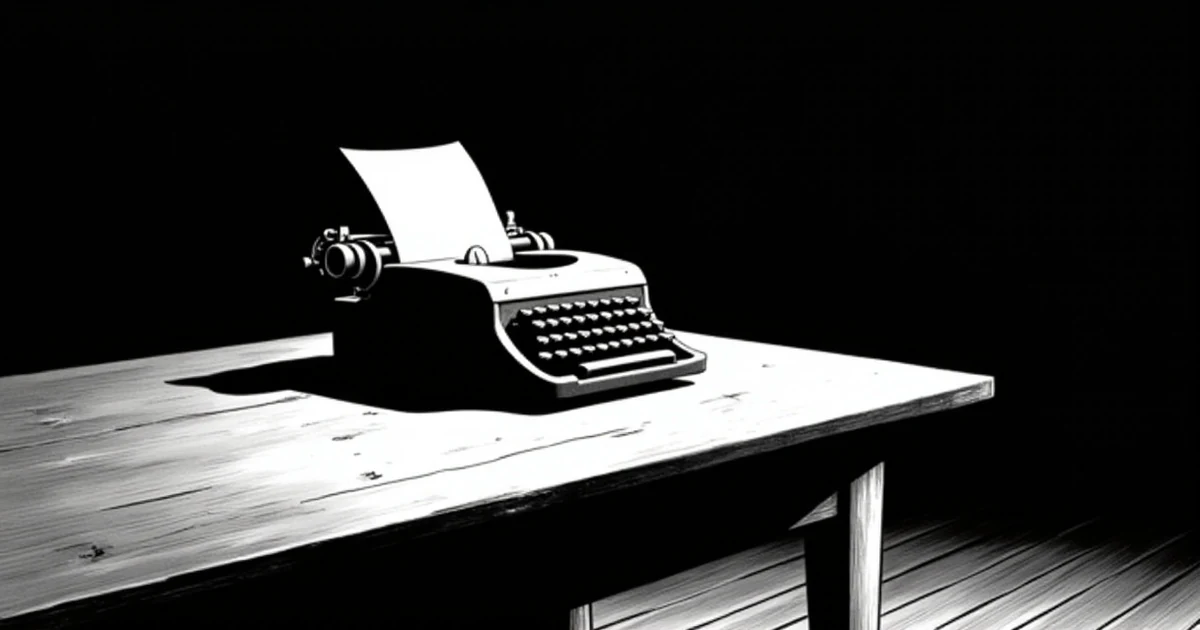
TL;DR: Austin Kleon has run twenty-four rounds of what he calls the typewriter interview, typing the questions on a manual machine and mailing them through the United States Postal Service to whoever he’s chosen. His latest is with cartoonist James Kochalka, eleven questions timed to the release of his book Johnny Boo: On The Go. One question, on whether Kochalka sees himself inside an artistic lineage, came back as a hand-lettered comic page instead of typed sentences, and the return envelope arrived with a fanged little monster drawn across the flap. He never named a single name.
Austin Kleon calls it the typewriter interview, and the mechanism matters more than the label suggests. He types the questions on a manual machine, no backspace, no delete key, and mails the page through the actual United States Postal Service to whoever he’s chosen. James Kochalka is his twenty-fourth subject, an award-winning cartoonist behind American Elf and Monkey vs Robot, timed to the release of his new book, Johnny Boo: On The Go.
What comes back is the subject’s choice entirely. Kleon doesn’t ask for typed answers. He asks a question on paper and waits to see what paper comes back. Four days before Kochalka’s letter went up, the same series ran a round with novelist Mark Haddon. Different subject, same slow machinery: type it, mail it, wait for the postal service to hand you back whatever the other person decided a typewritten question was worth answering honestly.
Here’s the one page I got to actually read: “Do you see yourself as part of an artistic lineage? Who would you place in your creative family tree?” That’s a deposition question dressed up nice, the kind that wants a list. Parents, teachers, the three cartoonists you stole your line weight from. Name them.
Kochalka didn’t. He drew a version of himself, ink-splattered, paintbrush in hand, and gave that version four lines of dialogue in hand-lettered balloons. “Back in art school I used to worry about my place and position.” Then, smaller, almost thrown away: “Never since then.” Then a balloon underlined three times, like he was leaning on the pen: “I love everything!” Then, in a balloon big enough to swallow the bottom corner of the page: “ALL art, all music, ALL MANKIND.”
Read that the way you’d read a transcript, listening for what got skipped. He was asked to place himself on a family tree and instead he told you what art school did to him, and then what he decided to stop doing about it, and then he answered a completely different question, one closer to “what do you feel when you make something,” which nobody asked him. That’s the tell. Fourteen years of depositions taught me that when a witness reaches for the enormous instead of the specific, “I love everything,” “all mankind,” the evasion is rarely on purpose. It’s that the honest answer doesn’t have names in it. A lineage question requires you to rank people. On the page, Kochalka refused to rank anything.
The envelope he mailed it back in wasn’t blank either. He drew a small fanged monster across the flap, claws splayed, a curling tail like a wave. Nobody asked for that. A typed letter doesn’t get you a monster on the envelope. A question that has to travel by hand, on paper that can be drawn on, apparently does.
Kleon’s own line about the exchange is that it turned out “fun and light and exactly like his comics,” which is generous of him and also correct, but it undersells what the format actually produced. Take away the keyboard, take away the edit, put a week of mail time between the question and the answer, and you don’t get a considered essay. You get whatever the person reaches for first when there’s no way to delete it. For a cartoonist, that’s apparently a drawing.
I only got to read the one page. I don’t know what he did with the other ten questions, whether he typed some of them straight, whether he drew every single answer, whether the fifth one came back blank. I don’t know if Mark Haddon’s page four days earlier looked anything like this one, or if a novelist under the same constraint reached for full sentences where a cartoonist reached for a monster. The format doesn’t promise consistency. It promises that whatever arrives is closer to reflex than to spin, and it leaves you holding one page at a time, guessing at the rest.
Comments are open to members. Sign up free →