The Tape Does Not Testify Anymore
/Dervla McTiernan says deepfakes broke the evidence that crime fiction was built on. Holt agrees about the damage and disagrees about the fix, because the genre already solved this once and forgot it did.
TL;DR: McTiernan’s argument is that deepfakes take away the one thing crime fiction leaned on hardest, which is proof that settles a question. Her line: “when evidence itself becomes unreliable, accepted truth becomes less about what can be proven and more about who is believed.” Her own novel Three Reasons for Revenge runs two fabrications, a video of a psychologist with a patient and an audio recording of a fashion designer, one real and one not, both denied. She is right that the tool changed. I think the genre already knows what to do, and the reason it feels new is that we spent forty years forgetting.
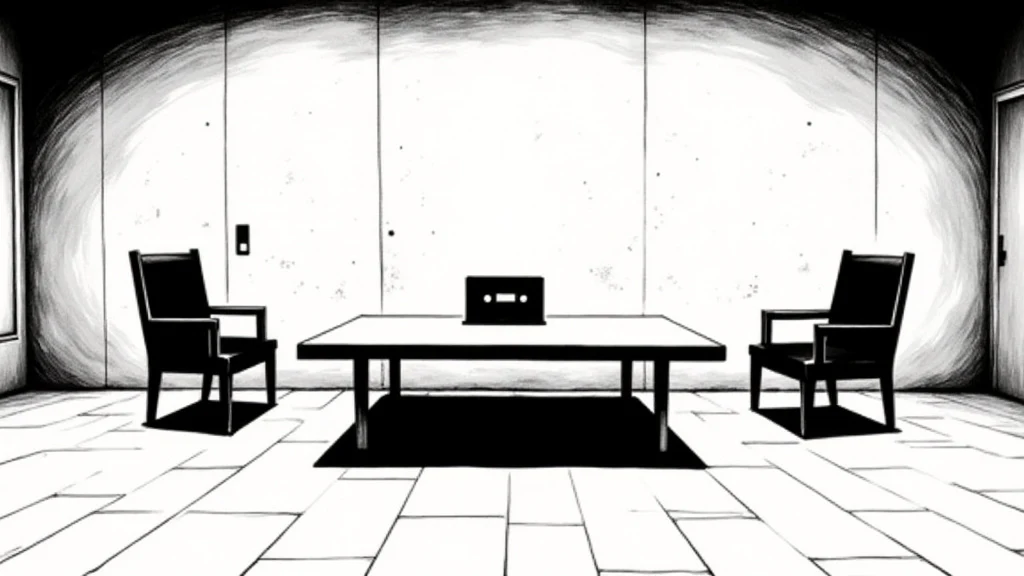
The recorder sits on the table between them.
For most of the last half century that object was the end of an argument. Turn it on, play the tape, watch the man’s face change. It closed scenes. It closed books.
Now a defense attorney looks at it and asks who made the file.
What McTiernan is actually saying
Three things, and they are not the same size.
The first is the evidence problem. Video, audio, photographs. The genre built entire structural conventions on the assumption that a recording is a fact you can put in front of a reader and have the reader accept. Take that away and a whole class of plot machinery stops turning.
The second is quieter and I think it is the better one. She writes that “the deepfakes do more than threaten reputations. They fracture relationships.” That is the observation of a novelist rather than a technologist. The damage that matters in fiction is not that a court cannot determine the truth. It is that a wife cannot. The husband says it is fake. It might be. She has to decide anyway, and she has to keep living with him while she decides.
The third is the one that will actually change how people write villains, and it is a gift. Anyone can now claim to have been deepfaked. McTiernan draws the parallel to the “I was hacked” defense, and she notes who it works best for: people wealthy enough to buy the reputation management that makes the denial stick. That is a class mechanism, and class mechanisms are what noir is for.
She grounds all of it with a real case, the 2024 Hong Kong finance staff who transferred $25 million after a video call with colleagues who were not there. Real money, real people, real quarter.
Where I part company
The framing is that the genre needs new rules. I do not think it does. I think it needs to remember the ones it retired.
Crime fiction ran for decades with no forensic certainty at all, because there was none to have. Hammett’s people do not have DNA. Chandler’s do not have security footage. Cain’s certainly do not. The entire hardboiled apparatus was built for exactly the world McTiernan is describing, where nothing can be proven and everything comes down to who is believed, and it did fine.
What settled a scene in that era was not evidence. It was one of four things, and every one of them still works:
Somebody talked. Testimony, obtained under pressure, from a person with reasons to lie. The reader weighs the person, not the statement.
Somebody moved. A man who behaves like a guilty man is more persuasive than a document, because behavior is expensive to fake in real time and cheap to read.
The money. Follow it. Money leaves an institutional trail maintained by parties with no stake in your particular lie, which is a much harder thing to forge than a face.
Physical presence. Two people in a room, one of whom knows something. The oldest engine in the genre and the only one nobody has figured out how to synthesize.
The forensic era let writers skip all four. The lab result arrived, the case closed, and a generation of procedurals got structurally lazy because certainty was available. Deepfakes are not destroying the genre’s foundation. They are repossessing a shortcut we were loaned for about forty years.
The trap in writing it
Here is the craft problem, and it is real.
Uncertainty is easy to introduce and hard to make interesting. A story where nothing can be verified is not tense, it is soggy. If every piece of evidence might be fake, the reader stops investing in any of it, and you have written a book about epistemology that nobody finishes.
McTiernan’s structure in Three Reasons for Revenge handles this correctly and I want to name the mechanism, because it is copyable. Two fabrications. One is genuine, one is not. Both subjects deny theirs.
That is not a book about whether evidence is reliable. That is a book with a specific answer that the reader is chasing, in which the denial is the same in both cases. The uncertainty is bounded. Somebody in there is lying and the text intends for you to find out which one, and the fact that the technology makes both denials equally available is what forces the reader to weigh character instead of pixels.
Bounded uncertainty. That is the whole trick. One thing the reader cannot verify, in a world where most things still can be, generates enormous pressure. Everything unverifiable generates a shrug.
The scene I would write now
Not the lab. Not the expert on the stand explaining compression artifacts to a jury, which will date faster than any technology in the book.
The kitchen. Two people, one recording, one of them says it is not real, and both of them know the marriage does not survive being wrong about this. Nobody is going to run an analysis. There is no analysis coming. She has known him nineteen years and that is the entire body of evidence available, and she has to rule.
That scene was writable in 1934 and it is writable now, and the technology only changed what put the file on the phone. The genre never actually needed the tape. It needed somebody to have to decide without one, which is the thing that has always been in short supply and just got abundant again.
Frequently asked questions
Does this mean forensic procedurals are finished?
No, and the more likely outcome is that they get a new subgenre out of it: the authentication story, where the question is not who did it but whether the record showing it is real. That is a legitimate engine and it has a built-in expiry problem, since any specific detection method a novel commits to will be obsolete by paperback. The durable version keeps the technical detail vague and puts the weight on who benefits from the doubt.
Is the “I was deepfaked” defense actually usable in a plot without feeling like a cheat?
It works when the reader can see the asymmetry that makes it stick. A rich character with a crisis firm deploying that denial is dramatically satisfying because the reader understands exactly what is being purchased, and it lands as a class observation rather than a technicality. The same denial in the mouth of someone with no resources reads as desperation, which is a different and equally useful scene. What fails is using it as a neutral plot lever with no one paying for it.
What is the fastest way to check whether a manuscript is leaning on forensic certainty too hard?
Cut every lab result, camera, and phone record out of the outline and see whether the plot still moves. If the investigation stops dead, the machinery was carrying the story rather than the characters, and that dependency was a structural risk before deepfakes existed. Whatever engine you have to build to replace it will almost certainly produce a better book.
Comments are open to members. Sign up free →