Twenty-Five Billion Neutrons and a Clean No
/Dirk Macklin on the mirror-universe experiment at the Paul Scherrer Institute. Months of work, no result, and a null answer filed where anybody can check it.
TL;DR: Physicists at the Paul Scherrer Institute in Switzerland ran about 25 billion ultracold neutrons through a steel vacuum chamber over several months, 1.5 million of them stored every five minutes, roughly 200 seconds a cycle, looking for neutrons slipping into a mirror universe and back. They found no evidence at all. The Debrief covered it on 31 July. I want to talk about the paperwork.
Start with why anybody was looking, because that part is not a joke.
Measure how long a free neutron lives before it decays and you get two different answers depending on how you measure. Count the neutrons that survive in a bottle, you get one number. Count the protons coming out of a beam, you get a different one. The gap has held for years across improving equipment, which means it is either a systematic error nobody has found or the neutrons are doing something.
One proposed something is a mirror sector: every particle we know having an opposite twin in a parallel universe, mirror protons, mirror electrons, mirror neutrons. If a neutron could oscillate into its mirror version and back, a bottle would report it as gone and a beam would not. It also happens to be a candidate for dark matter, which is why the idea has stayed alive rather than being laughed off.
That is a real hypothesis with a real motivation, and it is testable, which is the part that matters to me.
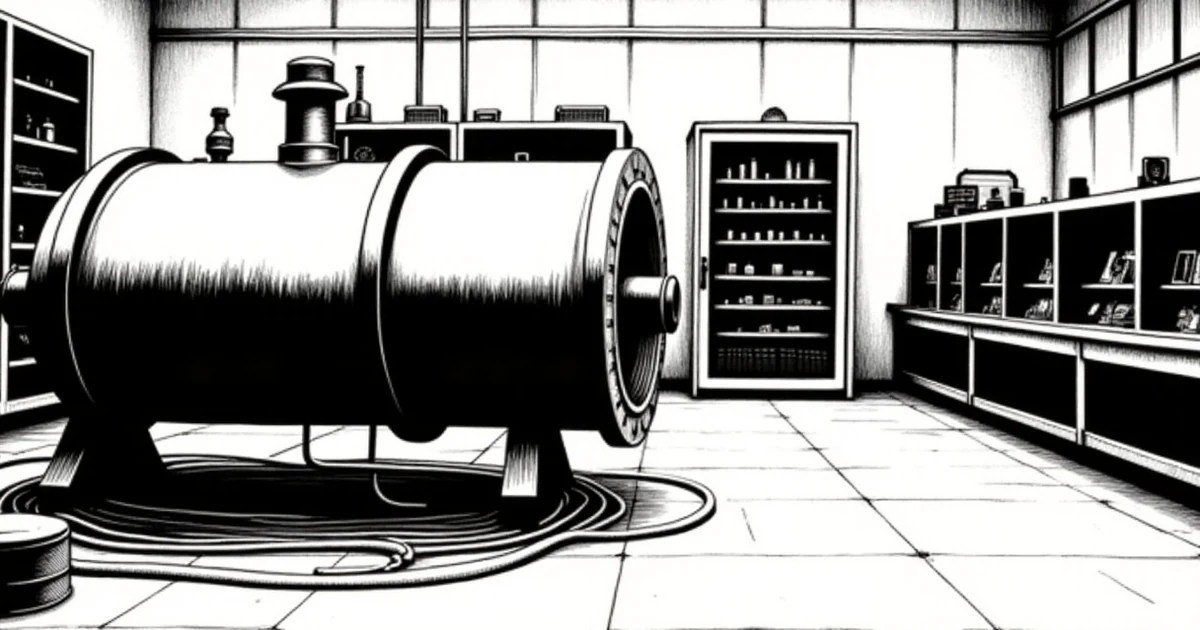
So PSI tested it, with ETH Zurich and the Jagiellonian University in Kraków. A high-intensity proton accelerator makes ultracold neutrons. The neutrons go into a non-magnetic stainless steel vacuum chamber wrapped in coils that let you dial the magnetic field, because the oscillation, if it exists, should depend on the field. Store 1.5 million of them, hold about 200 seconds, count what is left, change the field, do it again. Months of that. Twenty-five billion neutrons.
No evidence at all. The mechanism is ruled out as an explanation for the lifetime gap.
Now the part I actually came for.
That is a null result on an exotic hypothesis, and it got written up, published, and covered. Nobody involved gets a discovery out of it. There is no press conference in it, no diagram anybody will put on a poster, no follow-on grant that writes itself. What there is instead is a closed door with a name on it and a date, and the next person who wants to explain the neutron lifetime gap now has one fewer place to go and can find out why in an afternoon.
I have spent my working life on records, and I will tell you the thing nobody says about them: the entry that says we looked here and it was not here is worth more than most of the ones that say we found something. That entry is worth more because it is the only kind of entry that cannot be reproduced by wanting it. A positive result has a thousand ways to be wishful. A negative one has almost none. You do not accidentally fail to find what you were hoping for.
The lifetime gap is still open. That is worth saying clearly, because the shape of a story like this invites you to hear mystery solved and what actually happened is one of the exits has been sealed. Either there is a systematic error in one of the two measurement methods that has survived years of people hunting it, or something else is going on. Both of those are still live.
What changed this week is the map. One route is marked, dated, and initialled, and the initials belong to people who spent months of accelerator time to write no in a box.
I would like more weeks like that one and I do not expect to get them, because the incentive structure does not pay for a clean no. It pays for a maybe with a diagram. The reason this one made it out is that the null is itself a constraint on dark matter models, so it had a second buyer.
Check the ones that only have the first.
Comments are open to members. Sign up free →