A UFO crashed in Megaplatanos in 1990 and the case never left Greece
/Harlan Ross works the 1990 Megaplatanos crash, a case file that never made it into English-language UFO writing, off the original Greek sources.
TL;DR: On September 2, 1990, five or six objects moved across the sky over central Greece before one broke off, changed colors, and crashed on a hill above the village of Megaplatanos, ninety minutes outside Athens. The Karadratu family watched three explosions and shapes moving around the wreck for five hours, then found scorched pine, two holes in the ground, and a small antenna-bearing fragment stamped with a lightning bolt. Three separate official explanations followed, brush fire, downed satellite, meteor shower, and none of them explain the fragment or what five hours of family testimony described. Ghost Theory calls it the Greek Roswell. The case never traveled past the Greek border.
I file from places you cannot get a flight to, and the discipline never changes. A blotter line has a time, a street, a verb, and a hole in the middle where the reason ought to be.
September 2, 1990. A hill above a village ninety minutes outside Athens. Scorched pine, two holes in the ground, a fragment with a lightning bolt stamped into it, and a family who stood there five hours.
That is what was on the wall. I am not going to put a why on it. Be suspicious of the three people who did.
On September 2, 1990, sometime around nine at night, five or six objects moved across the sky over central Greece near Mount Pentelicus, tracking north past Thessaloniki before doubling back toward the Peloponnese and swinging north again. That flight path is the spine of a case file that Ghost Theory recently laid out in more detail than most English-language UFO writing has ever given it: Megaplatanos, a village ninety minutes outside Athens, and the night something came down on a hill above it.
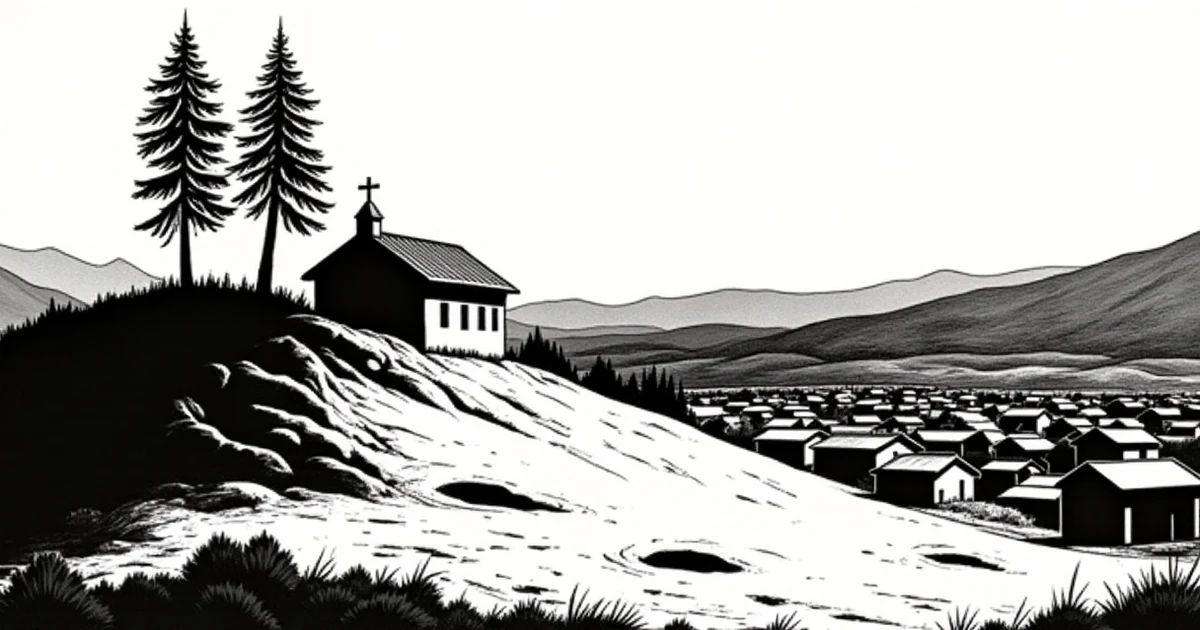
One of the objects broke pattern. It changed colors, dropped through some kind of erratic descent, and around 9:30 hit ground on Tympristos hill, near the Church of Prophet Elias, about a kilometer outside the village.
The Karadratu family watched it happen. Bright lights lit the sky for close to fifteen minutes, then three explosions loud enough to bring the whole household outside. One object came down trailing black smoke, the kind Mrs. Karadratu compared to burning tires. The others, she said, “descended near the grounded craft and landed around it, as if encircling it.” Shadows kept moving around the wreck from ten that Sunday night until three the following morning.
Daylight brought scorched ground, burned pine, two small holes punched into the hillside, and a piece of debris: small, circular, two antenna-like protrusions, and a symbol stamped on it that people kept describing as a lightning bolt.
Fthiotida police, a director named Panetsos and a deputy prosecutor named Zisimopoulos, walked the site and reported what looked to them like brush fire. They collected metal fragments, none over twelve centimeters, and shipped them to Tanagra Air Force Base, where the first read came back fast: junk, probably parts off an old fighter jet, worth nothing.
The Air Force’s own Research and Technology Center took the fragments more seriously. Its report, dated October 19, 1990, catalogued copper plugs, multipin cabling insulated in silk and Teflon, steel components, regulators stamped with the Greek letter “F.” Its conclusion split the difference: earthly, but not aircraft scrap. Old technology, the center guessed, maybe pieces of a dead satellite, European or Soviet.
An astronomer from the National Observatory, a man named Makris, waved off the sighting itself as a meteor shower compounded by bad atmospheric refraction, lights on the ground bouncing back up into the sky and reading like a formation of something.
Three official versions now sit in one file: brush fire, dead satellite, meteor shower. None of them accounts for the antenna piece, the lightning bolt marking, or the five hours of movement the Karadratu family described watching around the wreck.
A UFO researcher named Socrates Ekaterinidis pushed back on the satellite and jet explanations for a plain reason: no crater, no wreckage field big enough to match anything coming down from orbit at speed. He also flagged that none of the official reports addressed the lightning bolt marking directly, and he questioned whether the police who logged the fragments had looked closely enough to actually see any lettering on them at all.
The name Ghost Theory gives this, “the Greek Roswell,” invites a comparison that falls apart fast. Roswell got a press run, a cover story, decades of books and documentaries, a town that built an identity out of it. Megaplatanos got a police report, an Air Force memo, and a blog post. Nobody ever ran a full witness canvass. What photographs exist are scarce enough that most of the case still runs on secondhand description, translated secondhand at that, out of Greek-language sources like ufotruth-gr.blogspot.com and a Vice News Greece piece most American readers never saw.
A family watched shapes move around a burning hillside for five hours in 1990. Three separate government and academic bodies looked at what was left the next morning and came back with three different answers, and not one of them accounts for the lightning bolt. Thirty-six years later, the case still lives mostly on one Greek blog and whatever a handful of researchers on either side of the Atlantic bother to translate. Nobody outside Greece thought to ask about it sooner. Now somebody has.
Comments are open to members. Sign up free →