The alloy is the only surviving paperwork on a 3,500-year-old supply chain
/Chain of Custody's Dirk Macklin reads The Debrief's Hittite storm-god find for what was actually recorded, by whom, and what the unnamed lab never disclosed.
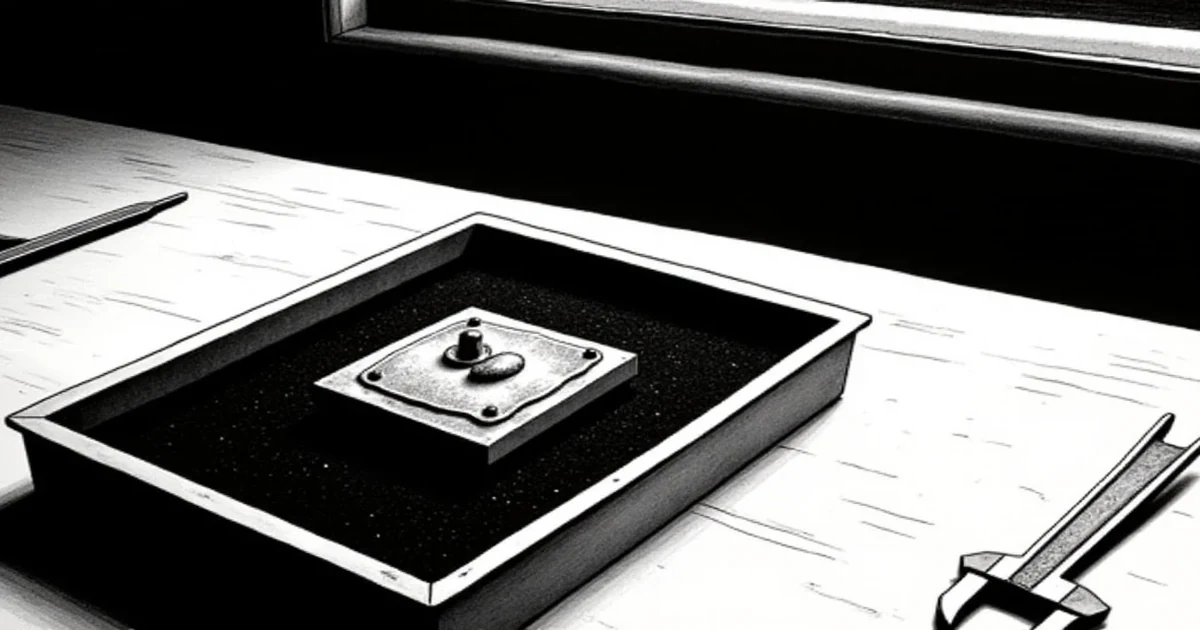
TL;DR: The Debrief reports a resident in Turkey’s Alaca district turned up a three-inch bronze figurine now on display at the Boğazköy Museum, cast from arsenical copper roughly 3,500 years ago and identified as a Hittite storm god. The arms and legs were cast separately and riveted to the torso through mortise sockets, an assembly method the piece calls a Hittite metalworker innovation. Governor Ali Çalgan called it “one of the best examples of its kind” at the unveiling. The article never names the lab, the dating method, or the alloy’s arsenic content, which is where the actual chain of custody breaks.
Eleven months at a folding table in a document review room teaches you one line and then holds you to it: what a record says is not what a record proves. Those are two different jobs and they use two different muscles.
This article says arsenical copper, 3,500 years, Hittite storm god. What it proves is that a museum put a figurine on a stand and a governor gave a quote at the unveiling. I am not saying the object is wrong. I am saying nobody has shown me the thing that would make it right.
The Debrief ran a piece by editor Micah Hanks on a small bronze figurine pulled out of the ground in the Alaca district of Çorum Province, central Turkey, and now sitting in the Boğazköy Museum’s permanent collection. Three inches tall, cast in arsenical copper, identified as a Hittite storm god. I host a show about reading a claim for what got recorded, by whom, and whether anyone followed up on it, so let’s do the arithmetic the article skips.
Start with what’s solid. A resident found it and turned it over to museum authorities instead of keeping it, which is the kind of decision that gets a region’s antiquities office a nice quiet Tuesday and a public unveiling. The dating holds at roughly 3,500 years, placing it in the Late Bronze Age, in a province that also contains Hattusa, the Hittite capital and a UNESCO World Heritage Site, so the regional context checks out. The assembly method is the most interesting verified detail: mortise sockets and pinholes on the shoulders and lower garment show the arms and legs were cast separately from the torso and head, then riveted on, the way a modern action figure gets assembled from molded parts. That’s not incidental. Casting a limb separately from a torso means a different pour, possibly a different day, possibly a different hand, then a fitting step that has to land within a tolerance small enough to hide the seam on an object you can palm. Nobody wrote any of that down. No smith’s name, no workshop ledger, no receipt for the ore. The only surviving record of the labor is the joinery itself.
Now the arithmetic that actually matters: arsenical copper. That’s copper alloyed with arsenic, not copper with impurities, either from ore that carried arsenic naturally or from a deliberate addition, and either way it required someone who knew which ore bodies ran hot with arsenic and how much heat and time to hold before the metal turned brittle or the fumes turned dangerous. That’s a supply chain, prospecting through smelting through casting through final assembly, with knowledge that had to move between people who never wrote a contract. The article calls this “advanced metallurgy” in its own headline. Fair claim, but here’s where the chain of custody actually breaks: the piece never names the lab that ran the analysis, never states a dating method, never gives an arsenic percentage, and attributes the whole identification to “experts” and unnamed “colleagues” quoted secondhand through the provincial governor at a ceremony. Ali Çalgan is a governor, not a metallurgist. His line, that it’s “one of the best examples of its kind,” is a compliment, not a citation.
None of that means the claim is wrong. The images reportedly already circulated at a Hittite exhibition in South Korea and got presented at the 8th Çorum Excavation and Research Symposium before this public unveiling, which suggests there’s a paper or at least a formal presentation sitting somewhere with the actual data in it. But that paper isn’t the one anyone’s citing. What’s circulating is a press write-up of a ribbon-cutting, dressed in the vocabulary of a peer-reviewed finding. The artifact is real, the joinery is real, the alloy is almost certainly real. What’s missing is the follow-up: who ran the assay, what percentage of arsenic, what method dated the piece to 3,500 years and not 3,200 or 3,800. Somebody has that record. It just isn’t in this article, and until it surfaces, the only ledger anyone can actually check is the metal itself.
Comments are open to members. Sign up free →