TL;DR: Every objection to AI is an accounting of who loses, and not one of them is wrong about the losses. I’ve taken all of them apart below and I’ve marked the two that beat me. So why is nobody running the other column? Because the people in it were never in the room. I’m in that column. I went from a zero percent VA rating to a hundred in under a year using these tools, after a decade of getting buried by an agency that counts on you quitting.
The wrong Tuesday
The woman behind the glass at the VA clinic told me my appointment had been Tuesday.
It was Thursday. I had that date in my head the way you have anything in your head. Solid. Mine. The kind of fact you build a morning around. I got up early for it. I drove there.
I was wrong.
That’s what a traumatic brain injury does to a calendar. Whatever you’re picturing right now is wrong, because you’re picturing forgetting, and forgetting would be a mercy. It doesn’t feel like that at all. It feels exactly like knowing, and the thing you know isn’t true. The damage doesn’t announce itself on the way in. It hands you the wrong number and lets you walk out the door with it.
So I missed appointments. More than once, over years, which means I wasn’t getting treated, which means everybody around me absorbed the cost of a man who wasn’t getting treated.
I tried email reminders. I’d see them. Then something else would come up and the reminder would slide off the edge of the day and be gone. You know what a reminder like that does for a brain that forgets like this? It documents the failure on its way past. Cool. Thanks.
What I have now is a thing I built with AI. It pushes the notification into the app I actually live in, and it won’t leave me alone until I confirm that I know about the appointment and that I’m going. It asks again. It keeps asking. It’s rude about it, on purpose, because I built it that way. I made myself a nag. Annoying little bastard. Best thing I ever shipped.
I haven’t missed one since.
The thread
It started with a reply on my phone, the way these always do.
I had used the word democratize about AI tools. A guy came back at me hard. Propaganda buzzword, he said. Corporate marketing language I had swallowed whole.
His side of it, made as strong as I know how to make it. If I put it on the page weak then I’m lying to you and you should stop reading.
Models were trained on artists’ work without consent and without payment. The output can imitate a living artist’s style at a speed and volume no human can match, and do it to someone whose name is on the work it learned from. The tools are moving into classrooms and commercial pipelines faster than anybody agreed to. Working artists are losing real income right now, that loss is documented, and I’ll put the numbers up myself so you don’t have to go looking. And democratize has been in every pitch deck ever assembled, so when a man hears it he’s right to check that his wallet is still in his pocket.
Then he asked the question I still haven’t put down: who gets hurt while humanity finds a new equilibrium?
Every one of those is a serious argument and I’ve been chewing on them for months. So here’s how I’m going to handle them, because a concession you don’t answer is just a surrender with better manners.
Where somebody has a number, I’ll take the number, out loud, even when it costs me. Then I’ll tell you why the number doesn’t get them where they’re trying to go. If I ever can’t do that second part, I’ll say so in the same breath and you should mark it against me.
Now do this. Read a hundred of those threads. Count how many mention a blind user. Count the stroke survivors, the people who can’t hold a pen, the ones writing in their third language to a landlord who’s trying to keep their deposit. Want to guess the number before you start? Go ahead. You’ll be high.
That count is the whole thing I have to say.
Every objection in the list is an argument about who loses. Not one is an accounting of who gains. Why would it be? The people who gain were never in the room to be counted, and you can’t miss a face you’ve never seen.
The guy who came at me has a partner who’s an illustrator. Everybody in that thread could already draw, or write, or see. I’m not accusing him of anything. That’s just the frame the entire debate runs inside, and nobody standing inside it can see the edges.
More than one in four American adults reported a disability in 2022. Roughly seventy million people. The most common type now is cognitive: trouble concentrating, remembering, deciding. (CDC, via Baptist Health)
That middle one is mine. The World Health Organization estimates 1.3 billion people worldwide live with significant disability, about sixteen percent of everyone alive, one in six of us.
That thread had maybe forty people in it. Do the math on who wasn’t there. I’ll save you the calculator. All of us.
In praise of scribes
In 1492 a German abbot named Johannes Trithemius wrote a book arguing that monks should keep copying manuscripts by hand. Parchment outlasts paper by centuries. Print neglects the spelling and the ornament. And the labor of copying is holy, because it builds something in the man who does it.
Two years later he had it printed.
He spent his life arguing for the hand. Then he sent it to a press. Art: Team Zer0
Every specific thing he said turned out to be false.
Print didn’t neglect the spelling. Print is the reason spelling got standardized at all. It didn’t neglect the ornament either; printed books carried woodcut initials, got hand-illuminated for the people who wanted that, and the finest engraved work in Europe came after the press, not before it. As for the copying being holy, that’s not a claim you can check. It’s a thing you assert when the checkable ones have run out.
And the scribes didn’t lose their trade. They moved. The print shops needed correctors, compositors, typecasters, people who could read Latin and spot an error, which is a description of a scribe. Colard Mansion in Bruges worked as a scribe and a printer at the same time. Writing masters were still a going concern a century later.
The ones who ended up with nothing were the ones who did what Trithemius told them to do.
That pattern doesn’t vary, and it runs on a schedule that starts a long way before the printing press. You have seen this movie. You just keep buying tickets thinking it ends different.
Go back to Plato. In the Phaedrus, Socrates passes along an Egyptian king’s verdict on the new technology of writing: it will “produce forgetfulness in the minds of those who learn to use it, because they will not practice their memory,” and it hands students “the appearance of wisdom, not true wisdom, for they will read many things without instruction and will therefore seem to know many things, when they are for the most part ignorant.”
That’s the complaint. It hasn’t changed in two thousand four hundred years. Scroll your feed tonight and you’ll find it again, typed into a machine by somebody who thinks he’s the first. We only know Socrates made it because somebody wrote it down.
In 1839 photography arrived and painters said it was the end of art. Baudelaire went after it in print twenty years later, calling the photographic industry “the refuge of all failed painters, too ill-equipped or too lazy to complete their studies,” and saying that by invading the territories of art it had become “art’s most mortal enemy.” Portrait painting collapsed as a middle-class trade and the men holding those brushes ate the loss the same way the weavers did, painting itself went off and invented Impressionism and abstraction and everything since, and a few hundred million people who would never have owned a painted likeness of anybody got a photograph of their grandmother.
John Philip Sousa published “The Menace of Mechanical Music” in 1906, warning that the ingenious purveyor of canned music would gut amateur playing and the musician’s living. Then what of the national throat, he asked. Will it not weaken? What of the national chest? Will it not shrink?
Sousa wasn’t wrong about the jobs, and this is the number the illustrators should have in their hands when they argue with me. About twenty-two thousand musicians were working in American movie theater pits in 1926, the year before The Jazz Singer. By 1934 there were roughly four thousand one hundred. The American Federation of Musicians fought it through a body called the Music Defense League, which bought national newspaper ads against canned music.
Some of those ads pictured a robot sitting at the instruments. That was 1928.
Eighteen thousand jobs, gone inside a decade. Some of that is the talkies and some of it is that nobody had a nickel for a ticket, and the sound engineer didn’t do all of it. Even at half it’s the ugliest number I’ve put in front of you, and it’s on my side of the argument. Now name me one person alive who thinks we should have stopped making sound films. Take your time.
Recorded music became the entire industry and live music didn’t die. Seventy years later drummers said drum machines weren’t real drumming, then everybody said sampling wasn’t real music, and in December 1991 a federal judge opened his opinion with “Thou shalt not steal” and held that Biz Markie’s uncleared sample infringed. That was one district judge’s preliminary ruling rather than binding precedent, but it ended the era of clearing nothing. Hip-hop and electronic music went on to become the dominant musical forms on the planet. Drummers still drum.
In 1985 a Mac and a LaserWriter landed on a desk and the typesetters called it amateur hour. The early work was amateur hour and the kerning was a crime, and none of that turned out to matter. Typesetting ended as a trade and publishing opened to anybody with a machine.
Photoshop shipped in 1990 and traditional illustrators said undo was cheating, that it wasn’t real painting, that the computer was doing the work. Art schools dragged their feet on teaching it. Digital is now the default medium of illustration and every working illustrator alive uses it.
Sit on that one a second, because it’s the closest thing in the pile to what we’re arguing about. The illustrator in that thread almost certainly works in Photoshop. Her own trade called her tool cheating, one generation back, in the same damn words being pointed at me now. Undo was the enemy. Undo. The goddamn button. I don’t have a paper trail on that one the way I do on Sousa, and I’m flagging it rather than dressing it up. What I’ve got instead is that I was alive for it and I read the argument the whole time it was running, for years, everywhere it ran. Ask anybody who was working in illustration in 1992 what the letters pages looked like. This isn’t a thing I heard about secondhand.
Phil Tippett was a stop-motion animator until 1993, when he watched the computer-generated dinosaur tests for Jurassic Park and said he thought he was extinct. His shop became a CGI house. He is still working.
The Luddites, since you know the word and probably not the story: skilled textile workers smashing frames from 1811 to 1816 because the frames were taking their trade, until Parliament made frame-breaking a hanging offense. Textile employment then multiplied, and their name became the insult you throw at somebody who’s scared of a phone. You’ve used it. So have I. And the aggregate hides the thing that actually happened to them: the mills hired different people at worse wages, often children, while the specific hand-loom weavers who smashed the frames went into the poorhouse and stayed there. They were right, nobody made them whole, and the trade grew anyway. Hold all three of those at once or you don’t understand the case you’re citing.
And then don’t hand it to me as an argument, because it isn’t one.
Somebody losing a trade to a machine is the oldest story we’ve got. It happened to the water carrier when the aqueduct came in and to the lamplighter when the wire came down the street, and it has happened at every step between there and the phone in your hand. Progress has never once gone any other way. Naming the cost is honest and I just spent five examples naming it. Handing me the cost as the reason to stop is a different move, and that’s the one I’ve got no patience for.
Run it all the way out. Global life expectancy in 1900 was thirty-two years. It’s seventy-three now. That did not move because anybody protected a trade. It moved because we kept going, and every damn step of the keeping-going took somebody’s living with it on the way past. Make the rule that everything stops when a job is threatened and you stop at the loom, you stop at the press, you stop at the plow, and you and I are dead at thirty-two with half our kids in the ground ahead of us. Nobody wants that rule. They want it applied to exactly one technology, right now, because this is the one that finally showed up at their own damn door. (Our World in Data)
Now the stupid part. A lot of the loudest voices on this want a world where nobody has to sell their hours to eat. Post-scarcity. No more grinding. I want that too. I’d like to live to see it.
There is no route there except straight through a machine that can do the work. People have sketched others, a shorter week and a tax on capital and degrowth, and every one of them is a plan for dividing the work up rather than for making it stop needing doing. And you don’t get to a world where nobody has to work by making damn sure the thing that could do it never gets finished. You’re standing in the middle of the goddamn road you say you want to walk down, waving your arms at the traffic.
And while I’m here: I would rather hand a pile of decisions to something with no ego in the game than to one more man with one. You can’t flatter it, you can’t buy it, and it hasn’t got a brother-in-law. I know the machine’s failure modes. They’re documented and I’ve named the ones that cost me. I also know exactly what a man with an ego and a donor list does with power, because we have six thousand years of receipts on that one and you can read them from any window in the house. Special interests own half of them and the other half are auditioning to be the next Trump.
Sousa was right about the cost and dead wrong about the outcome. Trithemius was wrong about all of it and told his monks to sit still, which is worse. Every single damn time, the outcome came back the opposite of the warning. If this is the one run where the pattern breaks, somebody needs to explain which part of it is different, and nobody has.
The ramp
Berkeley, the end of the 1960s. Disabled students wanted the curbs cut so a wheelchair could cross a street, and a few of them went out at night with a bag of concrete and poured their own. The police threatened to arrest us, one of them remembered. The city moved after that: on September 28, 1971 the council voted unanimously to cut fifteen intersections, and inside two years it had authorized a hundred and twenty-five more, sited by a committee of disabled residents. (The Berkeley Revolution)
Watch what a curb cut does once it exists. Every parent with a stroller uses it, every delivery guy with a hand truck, every traveler dragging a suitcase through an airport at a dead run, every kid on a skateboard. You used one today. You didn’t notice. Nobody argues about it now. (Stanford Social Innovation Review)
Built for the wheelchair. Used by the stroller. Art: Team Zer0
Closed captions were built for deaf viewers. Then everybody else turned them on. In a 2022 Preply survey, half of Americans said they watch with subtitles most of the time, and seventy percent of the Gen Z respondents did. Verizon Media and Publicis Media put it to 5,616 adults in 2019 and found eighty percent of caption users aren’t deaf or hard of hearing. They just have the sound off. (ReadSpeaker)
Talking Books were built by the Library of Congress in the 1930s for blind readers. Audiobooks are now a mass-market format, and people still say listening isn’t reading. Go say that to a blind man’s face. I’ll hold your coat.
Build the door for the people who can’t get in and everybody walks through it. You have been walking through those doors your whole life without once paying what it cost to hang them. Every accommodation anyone ever fought for came with that same receipt.
And they were all fought over.
The House passed its version of the Americans with Disabilities Act 403 to 20 on May 22, 1990, and it got there through a wall of organized opposition about cost and litigation and government overreach, with business groups lobbying hard and weakening amendments going up and getting beaten. (National Council on Disability) The head of Greyhound said leaving the definition of reasonableness to the courts was a scary proposition. (VCU Social Welfare History Project)
A year after it passed, an economist named Robert P. O’Quinn argued in a Cato Institute policy analysis for amending it, writing that “ideological zealotry often leads to demands that all relevant economic considerations be excluded,” and that “mainstreaming disabled individuals and assuring them access to any job are not necessarily worth any conceivable economic costs.” (Cato Policy Analysis 158)
The Department of Labor still runs an “Employers and the ADA: Myths and Facts” page answering the cost objection thirty-five years later, because the objection never died. The federal government still has to run a webpage explaining that a ramp will not bankrupt your damn sandwich shop. That’s where we are. (DOL ODEP)
Swap ramp for AI and small business for illustrator and you could run the 1990 op-eds today without editing a sentence. Same cost argument. Same who-really-needs-this. Same accusation of zealotry. That Cato paper is a post from this morning with better margins. Same fear, same math, same bullshit.
Not one person will defend that position out loud today. And most of the people who held it will look you in the face and tell you they never did. Everybody was on the right side the whole time, apparently.
I’m not assigning that to a party and I never will, because it was never a party. It was business groups, a think tank, and a lot of ordinary people who didn’t need the ramp and couldn’t work out why anyone should pay for it. The behavior repeats regardless of who’s performing it.
My read, offered as a read. A lot of the people arguing against the software ramp would never argue against the concrete one. Some of them marched for the concrete one. So what’s the difference? Whether they personally needed to get through the door. One variable, and I’ve quit calling it a coincidence.
Zero to a hundred
There’s a stack of letters from the Department of Veterans Affairs and every one of them says no.
Ten years of that. The VA system is built to bury you in rules and wait. Not maliciously, exactly, and not accidentally either. A dead file closes itself. A live one costs some poor bastard an afternoon. Everybody in that building can do that arithmetic. It isn’t a bug anybody has to fix, because it isn’t costing those fuckers anything. I don’t say that as a slogan. I say it because I read every letter in that stack and that’s what the letters describe.
In the decade before, I used everything the system offers.
I went to veterans service organizations. The volunteers there focused on what they couldn’t help with. After AI taught me how the process works, I understood they could have helped me the whole damn time. They either didn’t know how or didn’t want to, and I still can’t tell you which one pisses me off more.
I signed with a law firm at the starting line. Three months of dead silence, no strategy session, no evidence review. Around month six they called up friendly to talk about my case, by which point I was already sitting at 80 percent through my own filings, on my couch, with a laptop. I revoked the power of attorney and finished the climb alone.
Guess what they got.
Zero. I hope that call still itches.
Every other paid outfit I looked at was built to strip as much money off a veteran as it could get its hands on. Vultures with a website and a toll-free number, feeding on people who don’t know the rules yet. If you’re a vet reading this, don’t. Not one of them. Not ever. That’s the whole goddamn review.
So the old tools existed. They were people who didn’t know the regulations and companies charging money for not knowing them.
Zero to a hundred. Under a year.
“AI helped me navigate the VA” is exactly the kind of sentence a skeptic is right to throw out. You should throw it out. It sounds like every bullshit testimonial you have ever scrolled past. So here’s what actually happened, and you can decide.
It read every denial letter and told me what the letter actually said, which isn’t the same thing as what the letter appears to say. My entire health history, next. Then the specific regulations the raters were citing against me, taken apart one at a time until it found the places where the determination was wrong on the regulation’s own terms. We built the appeal on those points and nothing else. It drafted the whole thing in the language government raters expect to read, so there was nothing left in there for anybody to argue with.
I won on argument and citation alone. I never needed a nexus letter from a doctor.
What I’m describing is a paralegal, a medical records clerk, and a writer who knows the house style. Three people. Working full time for a man who couldn’t have paid any of them, and whose own brain lies to him about what day it is.
Getting to a hundred percent got me the healthcare and the treatment I needed.
It mattered so I didn’t decide to eat a bullet one day.
Ten years of letters, and every one of them says no. Art: Team Zer0
During that claim the tools contradicted themselves on specific rules more than once. They repeatedly made false claims on my behalf that I had to catch and correct before anything went out the door. Confident, well-formatted, wrong. If you want a stick to beat me with, there it is. I just handed it to you.
I caught them because I was reading every line. The claim won because I was in the pilot seat and paying attention to what the work was for, not because the machine was right every time. It wasn’t right every time. It wasn’t close.
That’s also the answer to the people who think a man with a brain injury using AI is a passenger being driven somewhere. A brain that scrambles dates still caught a machine misreading a regulation. So who’s the passenger? I’m the editor and the idea guy. The tool is the labor.
People ask what any of this is worth. Same answer every time.
It’s like having a personal assistant so I’m not such a burden on my family. It gives me autonomy and agency in my life that was missing.
I’m fiercely independent, and putting my disabilities on the people I love brought me shame I didn’t know how to put down. My wife tried to help and my wife has her own load to carry. The real cost of those missed appointments was never the inconvenience. It was that I wasn’t getting treatment, and that hurt my family worse than anything else did.
Other people
Nathan Johnston is fifty, lives in Tasmania, and had a stroke ten years ago that took his language away.
Before ChatGPT he communicated in single words and emojis. Now he writes full texts, emails, social posts. He learned it through a student-run speech pathology clinic at the University of Technology Sydney, supervised, over months.
His mother sent him a gift from Spain. This is what he was able to write back to her.
Yes, it fits perfectly! I really appreciate you thinking of me and bringing it back from Spain. It’s such a thoughtful gift, and I absolutely love it.
(UTS)
One message to his mother. Ten years of not being able to write one.
There’s clinical work under it too. A case report in Frontiers in Rehabilitation Sciences followed a 75-year-old man eight years out from his stroke who wanted to write his autobiography and couldn’t. With ChatGPT helping him edit, he produced more sentences with fewer errors, and he generated enough of them to have a life-story book printed and handed out to his friends and family.
A year later he was still using it, for songwriting instead of memoir, and the researchers note that they never measured how independently. (PMC)
Aphasia affects roughly two million people in the United States. Count how many of them were in that thread.
The clinician on the UTS work says two things I’d rather weren’t in here. Not everyone can get to these tools or use them. And early on, Johnston needed a trained professional sitting with him and prompting him before he could get a word out of the thing. That’s the person who watched it happen, standing on my side of the argument, which is why it costs me more than anything the guy in the thread ever said.
Then the blind users, where there’s a clean before and after.
Be My Eyes spent years connecting blind users by video to a volunteer network that has since grown past ten million sighted people, and you waited for one of them to pick up. In March 2023 they wired GPT-4’s vision model into the app, and opened it to everybody that September. Now you photograph anything and get a description you can ask questions about, and you don’t have to ask a human being for anything.
Because it answers in text rather than speech, it also reached deafblind users, who read it off a refreshable braille display. (Be My Eyes)
The detail that made me understand it comes from Andrew Leland, who wrote a book about going blind, relaying a demo he had heard. A blind man had been to Disneyland with his family and asked his phone to describe the photo.
The iPhone said: image may contain adults standing in front of a building.
GPT-4 said: there are three adult men standing in front of Disney’s princess castle in Anaheim, California. And then he could ask it whether any of them had mustaches. Mustaches. The detail that ought to get you is that none of it is information. It’s a man getting to be nosy about his own family photo, same as everybody else. (Watermark, summarizing IEEE Spectrum)

Point it at the room and ask what’s in there. Art: Team Zer0
Aaron Preece, who edits AccessWorld at the American Foundation for the Blind, wrote it up like this: “2023 saw one of the most significant accessibility breakthroughs since the advent of the accessible smartphone.” (AFB)
And it gets things wrong. A blind artist testing the tool on a photograph found errors in the description of the image. (Culture.org) That belongs in here as much as the rest of it does. You think I’d leave it out and let you find it? Come on.
Dyslexia next. Myriem Khal was 23, studying computer engineering at Compiegne, good at math and science, and finding reading and writing in English punishing. She started prompting ChatGPT in French to restructure her course material, then checked every answer against her class notes. “I got great marks for my final exams,” she told Business Insider. “It’s just a tool.”
Xin Zhao, Xuanning Chen and Andrew Cox surveyed 124 disabled students in British higher education, most of them neurodivergent or dyslexic, and found three things the tools were good for: getting a thing explained, getting it expressed, getting it planned.
That same study found the tools did nothing at all for the two barriers those students named most often, which were low motivation and bad time management. Turns out the machine can’t make you give a shit. Nothing can. That part was always yours. It also flags accuracy problems, the cost of the good models, and dependency. All three stay in. It’s the shape of an honest finding, and dependency is the fairest objection in the whole file.
Speech and motor disability. Voiceitt trains itself on speech that ordinary recognition can’t parse and renders it clearly. Michael Cash, who has cerebral palsy, says he can dictate emails and work documents faster than he could ever type them, and send WhatsApp messages from his phone like anybody else. Cash is also Voiceitt’s product manager and helped build the feature. He is describing his own life and selling his own product in the same sentence. Weigh it accordingly, and notice that nobody is better placed to say. (NoCamels)
And people writing in a language that isn’t their first. Non-native English speakers are the heaviest users of AI writing tools, and the productivity gains land hardest at non-Anglophone institutions. There’s a cruel joke folded into that. Stanford researchers ran seven commercial AI detectors over TOEFL essays written by non-native speakers under exam supervision, which is about as unambiguously human as writing gets, and the detectors came back with an average false positive rate of 61.3 percent. All seven agreed on a fifth of them. Against essays by American eighth-graders the same tools were near perfect. (Liang et al., arXiv)
So the tool everyone is fighting about is the one that lets a non-native writer stop getting accused of cheating by the other tool everyone trusts. It’s the funniest thing in here and nobody is laughing.
Now make it a lease dispute letter. A medical portal. A school form for your kid that decides whether they get help. Still want to argue about a buzzword?
Steven Aquino made the case in MIT Technology Review in 2024: artists who can’t draw in the conventional manner could use voice prompts to have a model render what they’re picturing. “That might be the only way for such a person to indulge an artistic passion.” (MIT Technology Review)
An artist who can’t hold a pencil is still an artist. Put that next to the illustrator argument and leave it there.
The old tools already existed
Screen readers existed. Dragon dictation existed. Spell check has been on every computer since before you were born. I have had all three of those typed at me, usually in that order, usually by somebody who has never run any of them.
All true. And all of them assist a skill you already have.
Dragon transcribed your words. It didn’t fix your sentence. Spell check corrects a word you nearly spelled; it can’t write the paragraph for a man whose language center took a hit. The old iPhone told a blind user there were adults in front of a building. The new one names the castle and reads the shirts.
Nothing here handed me a skill I never had. I had the skills. I have a degree of them. What the injury took was not the knowing, it was the reaching. A brain injury doesn’t delete what you learned. It builds a wall between you and it, and then it makes you watch yourself fail at something you can still do.
The tool climbs that wall. It doesn’t do my thinking and it doesn’t decide what any of this is for. It does the hauling, which is exactly the part the injury took, and it amplifies what’s left, which is why the sentence I keep coming back to is the one about agency and not the one about ability.
Same as a ramp. A ramp doesn’t teach anybody to travel. They already knew. It removes the eight inches of concrete standing between them and the thing they could always do.
The cost gate
The dyslexia studies name it, so I will too.
The good models cost money. Disabled people are broke. Disability gets more common the further down the income scale you go, which isn’t a coincidence either, and every gain I’ve named sits behind a card on file. Mine included. That subscription is a rounding error to you and it’s a decision for a lot of us.
And the money is the easy half of what that clinician said. The hard half is the professional in the room. Johnston needed one for months before the tool did a thing for him, and there is no version of my argument where a stroke survivor in a county with no speech pathology clinic gets what Johnston got. What I had was a subscription and a wall to climb. What he had was a subscription, a wall, and somebody from a university sitting next to him for months. I’ll come back to what a freeze does to a price. Nothing I’ve got does a damn thing about the second one.
That’s where I’d have left it, until somebody asked me the obvious question and I couldn’t answer it.
How many people were watched? How often was it wrong? I went looking and there is nothing to find. The UTS work isn’t a published trial with an N and a confidence interval. It’s a university clinic that’s been testing this for two years, and what reached me was one man in Tasmania. So her caution is a clinician’s impression, which is worth real money, and my side of it is a single case, which is worth about the same. I’m not going to hold her to a standard I just failed in the previous paragraph.
Here’s what that caution can’t carry, though, and I want to be careful, because she was being honest and she’s standing on my side of this.
Set it against what we accept everywhere else. Diagnostic error kills or permanently disables an estimated seven hundred and ninety-five thousand Americans a year. Johns Hopkins, in BMJ Quality and Safety, with vascular events and infections and cancers doing three quarters of the damage. Nobody reads that number and proposes we stop having doctors. We try to make them wrong less often, because there is no perfect clinician standing behind the imperfect one. There’s nobody. (Johns Hopkins Medicine)
Then run the consequences side by side, because that’s where this stops being close. A speech pathologist gets it wrong and a stroke patient loses months. A surgeon gets it wrong about which artery and somebody’s family gets a phone call. This tool fails a man with aphasia and he is exactly where he was that morning. That’s the entire goddamn downside. He goes back to not being able to say the thing, which happens to be the condition the objection wants him left in permanently, on purpose, as policy.
So it doesn’t work for everybody and some people need a professional in the room to start. Both of those are true and I’ve now said both. Neither gets you to taking it off the table. They get you to more clinics, cheaper access and better tools, which is the same list I’ve been reading off since the top of this thing.
And there’s a harder one underneath it that I keep leaning on the ADA without answering, so let me answer it.
The ADA did not just open doors. It sent the bill to the people who’d been keeping them shut. Greyhound argued it would cost too much and Greyhound got overruled and Greyhound paid. That is the actual mechanism of the thing I keep holding up as the good example.
Now look at what the courts did here, and I’ll lay the rulings out properly in a bit. The shape of it is that training got called transformative, style was never copyrightable, and the only money that changed hands was for the pirated copies specifically. Access got built and the people whose work it got built out of got a settlement for the theft and nothing for the ramp.
If you want me to read this as the ADA, an illustrator is entitled to say: then send me my check.
She’s right. Anybody on my side who weasels that is part of the damn problem. If the accessibility case is real, then the compensation case is real on exactly the same logic, and me winning my argument doesn’t settle hers. A licensing market with actual money in it is the thing I want, and I want it for the same reason I want the tool: because the alternative is one group of people carrying the cost of somebody else’s access, and I know precisely what that feels like from the other side.
One more objection, and it’s the one I respect most, and nobody in that thread made it. The accessibility case is real and it’s also every incumbent’s favorite shield. Developers hid behind the ramp the same way. Every corporate atrium got called accessible while the bathroom stayed on the half floor.
Somebody using a ramp cynically tells you who keeps paying for ramps, and it has never once been a reason to take them out.
The operator
The strongest thing anybody says against these tools is that they make people worse at the craft. The disability studies raise the same worry from the other direction, that a user gets dependent and loses ground.
The dependency one is real and it’s the fairest thing anybody has said to me. The craft one is real too, and it’s aimed about fifteen degrees off from where the damage actually is.
Hand it the whole job including the thinking and you produce slop, and the internet is currently ass-deep in the output. That part is on us. Every bit of it. Learn to run the goddamn thing and the work holds up. A nail gun never ruined carpentry. It ruined carpenters who stopped measuring.
And this is the one I want on my headstone. A crutch is only a problem if you could walk without it. For a working illustrator, erosion takes something she has and uses every day, and losing it is a real loss. For me the reaching was already gone and the tool is how I get at what’s still in there. You cannot erode a skill by finally being able to use it again. Same tool, opposite meaning, depending entirely on where you started.
As for whether the output holds up, there’s a study I’m going to spend properly later on, so here it’s one line. Sears and Weisberg at Villanova put 2,587 people in front of short stories and asked them to sort the human ones from the machine ones. The readers came in under a coin.
Expertise in literature didn’t help readers spot it. Familiarity with AI did.
That was prose, and prose is all it tested, and I nearly stretched it anyway. So, the honest version: it tells you that people who read for a living, asked to spot machine-written stories, did worse than a coin. Whether an illustrator’s trained eye beats that on images is a different question with a messier literature, and I don’t get to borrow this study’s authority to answer it. What I’d say to somebody certain she can always tell is that the last group of experts who were certain got tested, and it went badly.
The word
Back to the curb for a second, because the argument that started all of this was about vocabulary.
The guy was right that democratize has been beaten to death. Every deck says it. Every launch post says it. The word is a corpse. It’s been carrying water for companies selling access to things they own, and if it makes your skin crawl, good. It should. Mine too.
So take the maximal version off the table. Everyone can now be an artist is marketing, and I’m not defending marketing.
The version I’ll defend all day is narrower than that. People who were locked out of ordinary functions have the lock picked, not the ability installed. Reading a menu. Writing an email that has to sound competent because money depends on it. Seeing the photograph your kid sent you. That’s a curb cut, built for the wheelchair, used by the stroller.
The second point he was right about is worse than the one he was arguing. These tools belong to four or five companies. Access can be priced, throttled, or switched off, and none of the people relying on it get a vote. That’s a real structural problem and it’s a far better argument than they stole it.
The case doesn’t depend on the word. Drop the word. The door is still open, and there are still people standing in it who weren’t standing anywhere before.
The record
Anthropic bought physical books, cut the spines off, scanned them, and destroyed the originals. Every one of them. Gone.
A federal judge looked at that on June 23, 2025 and ruled it fair use. Judge Alsup, Northern District of California, in Bartz v. Anthropic, held that using the books to train the models was “exceedingly transformative,” and that the purpose and character of the training was “transformative, spectacularly so.” He also ruled that downloading millions of pirated copies from the shadow libraries wasn’t fair use, and that part was never close. (Reed Smith)
Anthropic settled the piracy side for one and a half billion dollars, roughly three thousand dollars a book before fees, across the 482,460 works on the court’s list. Judge Martinez-Olguin signed the final approval on July 20 of this year and overruled all fifty-three objections. Largest copyright class action settlement on record. (Wolters Kluwer Copyright Blog)
Two days later Judge Chhabria gave Meta the same result in Kadrey and then spent the order limiting it. His ruling, he wrote, “does not stand for the proposition that Meta’s use of copyrighted materials to train its language models is lawful,” only “that these plaintiffs made the wrong arguments and failed to develop a record in support of the right one.” He warned that a use can be highly transformative and still lose, and pointed at a market dilution argument nobody has tested yet. (Jackson Walker)
And style has never been copyrightable. Copyright covers a particular expression, never the manner of expressing it, and the Copyright Office said so again in its 2025 report on generative training. That has always cut both ways, and it protected every artist who ever built a style out of the three painters they loved most.
I’m not carrying water for these companies. That settlement number says what it says. The theft was the piracy, and the piracy got punished at a scale nobody in publishing had ever seen. And Alsup ruled the training itself transformative, flatly, on the record in front of him. Chhabria ruled for Meta on a narrower one and then told you himself not to read it as a green light, which is why I quoted him saying so instead of counting him as a second vote. One clear ruling and one that refuses to be one. You can think both were wrongly decided. I do, in places. You can’t pretend they didn’t happen.
Models don’t learn like humans do. My own side says they do and my own side is wrong about it, and I’ll keep saying so until they quit. They compress patterns at industrial scale and they can memorize. The New York Times attached a hundred and twenty-seven pages of side-by-side comparisons to its complaint. OpenAI disputes how those outputs were produced, and the case is still in discovery. Anybody telling you a model reads a book the way a person reads a book is selling you something.
They stole it is a slogan, and a slogan ends a conversation. What should a licensing market look like is a question that starts one. One of those gets artists paid. Guess which one everybody’s shouting.
Both columns
An illustrator opens her email on a Monday and the client who sent her work every month for six years isn’t there anymore, and won’t be next month either.
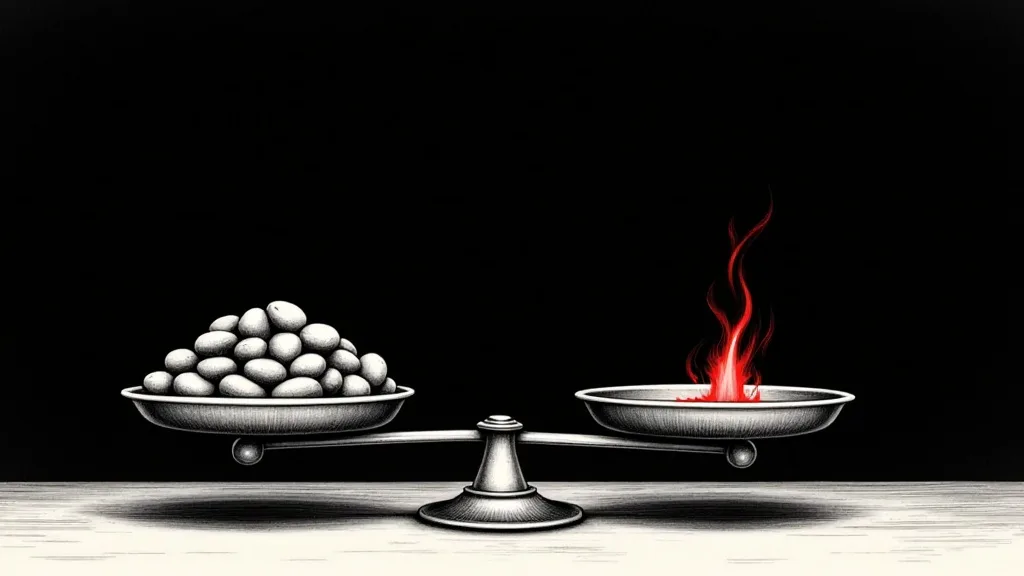
One pan gets counted in stones. The other one is still burning. Art: Team Zer0
Happened, documented, and it has a number on it.
The Association of Illustrators surveyed 6,844 illustrators in January 2025 for the UK government’s copyright consultation. Just over 32 percent said they had already lost commissions to AI, at an average of £9,262 each. (Design Week)
A Society of Authors survey of 787 authors, illustrators and translators in January 2024 found 26 percent of the illustrators and more than 36 percent of the translators had already lost work to generative AI. (80.lv)
On the freelance platforms, one study measured a 17 percent drop in job posts for image-creation work once the image generators arrived, and a 21 percent drop in writing and coding posts in the eight months after ChatGPT. A study of Upwork found image freelancers losing 3.7 percent of their monthly jobs and 9.4 percent of their monthly earnings, and the highly rated ones weren’t spared. (arXiv)
Now the other side of the same ledger. A 2026 study in the Journal of Cultural Economics by the researcher Christos Makridis matched an occupation-level AI-exposure index against Bureau of Labor Statistics wage data and Census microdata through 2024, and found little sign of a broad decline in artists’ earnings. Pay in the most exposed artistic occupations tracked pay in the least exposed. Self-employed artists in the exposed occupations came out slightly ahead. (Gallup)
A freelance illustrator losing a third of her income is true. A man in Tasmania writing his mother a thank-you note is true. Nobody has ever had to hold both of those, because until right here nobody has printed them on the same damn page.
My position on the illustrators, said plainly so nobody has to guess: this is photography in 1860 and digital art in 2005, and the ones who adapt are the ones still working in ten years. I think they should adapt. Yeah, I said it. That’s a position and not a concession, and I know exactly how it sounds coming from a guy the tools happened to help. Say it back to me in the comments. Say it uglier than that if you want.
What I won’t do is pretend the number isn’t there. A critic with one link would end this piece.
Nobody is taking this away from her. She’s putting it down.
Go back through my five and price the wall each of them was standing at. The scribe couldn’t buy a printing press, and the ones who got across got across by walking into somebody else’s shop. The portrait painter needed a camera, a darkroom, a working knowledge of chemistry and several years. The pit musician couldn’t become a sound engineer in an afternoon. The typesetter in 1985 was looking at a Mac and a LaserWriter that together cost more than a car. Every one of those people had something between them and where the work went, most of them never got across it, and that is the part of their objection that was always right.
Now price this one. Twenty dollars a month and a couple of weeks of paying attention. She can open the same tab I opened, for the same money I pay, on the machine she already owns and is already working on.
The technical wall is nothing. It’s also not the only wall. People get flagged, delisted and dropped by clients for crossing it in public, they lose work over it, and that cost is real and it counts against me.
The scribe’s wall was a printing press. The typesetter’s wall was five thousand dollars of hardware. Neither of those was built by anybody. They were just the price of the thing.
Hers is built. By people. On purpose. The illustrator who wants to learn this and keep her client list is being kept out by other illustrators, and that is a different animal entirely from a machine costing more than she has.
That has never been true before. Not once in the five. And it changes what the refusal is, because when the hand-loom weaver couldn’t cross, that was a wall, and when you can cross for the price of two coffees and you stand there instead and call the far side impure, that’s a decision. You made it. Nobody made it for you.
Read what that AOI number actually counted, too. Illustrators who lost commissions. It didn’t count illustrators who learned the thing and lost anyway, because nobody thought to ask, and I have a guess about why.
And no, this doesn’t cancel what I said about the check. Being owed money for your work ending up in a training set, and keeping up with your own trade, are two separate arguments. You can be owed the first and still be losing the second on your own. A bill somebody else hasn’t paid you is not a defense against a choice you’re making.
She’ll say the client just generates it himself now and there’s no commission left to adapt into. That’s already happening at the cheap end, exactly the way the portrait painter’s bread work went when a photograph got to be a dollar.
Two things about that. The client generating it himself produces what a client generating it himself produces, which is why the ones who tried it in 2023 came back. And the illustrator who runs the thing with thirty years of judgment behind her eye beats the client’s afternoon every time, on the same tool, at ten times the speed she used to work at. That is not a consolation prize, it’s the actual job now, and it’s hers to take or leave.
Leave it, and the money still goes. It just doesn’t go because of me, or the tool, or the four companies. It goes because she decided the far side of a twenty dollar wall was beneath her, and that’s the whole damn tragedy of it.
And there’s a column underneath all of this that nobody runs at all, which is what any of it was ever worth in the first place.
I’ve had commercial illustration quoted to me at two and three hundred dollars a go, and I’m not going to pretend I ever understood what I was paying for. Here’s the honest answer, and it isn’t an accusation against anybody holding a stylus: that price was set by how few people could do it. Not by how good it was. Every gated trade in here priced the same way, and every time the gate came off the price came down. The scribe charged what he charged because you couldn’t read Latin. That’s not greed. That’s arithmetic, and it’s the arithmetic she’s on the wrong end of now, which is exactly why I said her loss is real and I’ll say it again.
But the standing is a different question, and this is the part I’ve got no patience left for.
In 2019 Maurizio Cattelan taped a banana to a wall at Art Basel Miami and sold three editions of it for something between a hundred and twenty and a hundred and fifty thousand dollars. In November 2024 Sotheby’s put one of them up with a million-dollar estimate. Seven minutes of bidding later it went for six point two million to a crypto guy, six times the estimate, and then he ate the goddamn thing on a stage and said the real value is the concept itself. (The Art Newspaper)
Now hold that next to the standard they want applied to everybody else, the one where art is the toil and the hours are what make the thing real. Watch it come apart in your hands. If the labor is what makes a thing art, then Comedian isn’t art, and somebody needs to go tell Sotheby’s. If the concept is what makes a thing art, then the man who typed a careful description of what he wanted and got a picture back has made one, and the entire objection is over. You cannot run both.
And I don’t have to argue that second half, because Sotheby’s already argued it for me and put it in writing. What actually went under the hammer was not a banana. It was a certificate of authenticity and fourteen pages of instructions telling the owner how to tape a piece of fruit to a wall at the right height and the right angle. The buyer supplies his own banana and replaces it himself when it rots. Six point two million dollars for a written specification of what the artist wanted somebody else to go and do. (Sotheby’s)
That’s a prompt. The most prestigious auction house on earth sold a prompt for six point two million dollars and issued paperwork certifying it as an original, and the same world that cleared that transaction looks at a man who typed a description of what he wanted and tells him he hasn’t made a damn thing. The art world settled this question against itself a century ago with a urinal and it has been cashing the checks ever since, and now the toil standard gets picked back up off the floor exactly when a disabled man reaches for the same door.
And there’s a third column in that story that nobody ran, which is the only reason it’s in here. The banana came off a fruit cart on the sidewalk outside the auction house. Shah Alam, seventy-four years old, twelve-hour shifts, a basement apartment in the Bronx, sold it for thirty-five cents. He found out what it went for when a reporter told him. I am a poor man, he said. I have never seen this kind of money. He didn’t get a cent of it, nobody in that room thought he was owed one, and not one of the people who have lectured me about the sanctity of artistic labor has ever said his damn name. (The New York Times, via East Side Feed)
Six point two million dollars for the idea. Thirty-five cents for the work. Tell me again which one of us doesn’t respect labor.
Some people get hurt. Some people who were already hurt get something back. Run one column and call it a total and you’re doing PR with a calculator on the desk.
The experts don’t know either
On February 27, 1995 Newsweek ran a piece by Clifford Stoll under the headline “The Internet? Bah!” He listed what the visionaries were promising, telecommuting and interactive libraries and multimedia classrooms and commerce moving from malls to modems, and answered: “Baloney. Do our computer pundits lack all common sense?”
In 1998 Paul Krugman wrote in Red Herring that “by 2005 or so, it will become clear that the Internet’s impact on the economy has been no greater than the fax machine’s.” He has said since that he was trying to be provocative and got it wrong, which is fair, and it’s also on the record forever.
Nicholas Carr asked in 2008 whether Google was making us stupid. Still argued about. The cognitive collapse hasn’t shown up.
In the 1950s television was going to destroy reading and conversation and childhood. Reading rates went up through the twentieth century.
In 1954 a psychiatrist named Fredric Wertham convinced a Senate subcommittee that comic books were producing juvenile delinquents. His papers reached researchers in 2010, and in 2012 the librarian Carol Tilley published an examination of them documenting how he had “manipulated, overstated, compromised, and fabricated evidence” for rhetorical gain. In the 1980s it was Dungeons and Dragons, then video games, with hearings attached, and no causal link ever established. You probably played both. You seem fine.
None of those people were stupid. Several were the most credentialed voice available on the subject at the time. Expertise in how a technology works is a completely different thing from expertise in what a society does with it, and the second one doesn’t exist. Nobody has it. Not Krugman, not Carr, not the guy in your feed with the thread. Nobody called the internet’s shape in 1994 and nobody called the smartphone in 2005.
I’ve been told what my future looks like by experts before. For ten years the letters said no, and every one of them was signed by somebody whose job it was to know, and a machine that costs twenty dollars a month read the regulations they were citing and found where they were wrong.
So when somebody tells me they know how this ends, I’m not impressed by the credential. I’m not impressed by yours either, and you shouldn’t be impressed by mine.
That cuts at me too. If nobody can predict this, then I can’t predict it either, and I won’t try. I can tell you what might go wrong. I can’t tell you what will. Everybody shouting at me runs those together and then acts like I signed something.
The insiders get handed to me like a trump card. The researchers who were in the building and came out against it.
I’ll run the motive test on them, since I’ve been running it on everybody else. Some of it lands. Timnit Gebru was out of Google at the end of 2020 over a paper, Margaret Mitchell followed a couple of months later, and OpenAI fired Leopold Aschenbrenner and Pavel Izmailov in 2024 over what it called leaking. People who get thrown out of a building tend not to speak warmly about the building afterward, which isn’t a character flaw, it’s just people.
And then it stops landing, and I’m going to say so rather than let somebody else say it for me. Geoffrey Hinton wasn’t fired from anything. He quit, at seventy-five, so he could talk. Jan Leike resigned. Daniel Kokotajlo resigned and gave up something like one and a seven-tenths million dollars in equity rather than sign a paper promising not to criticize his old employer. (Fortune)
You cannot call that grievance. A man who pays one point seven million dollars for the right to say a thing believes the thing. That’s about as expensive as sincerity gets, and anybody running the bitter-ex-employee line on him is doing the thing I’ve spent this whole piece complaining about: picking the facts that fit and skipping the ones that don’t.
Believing it doesn’t make it so. Paying for the right to say it doesn’t make it so either. Kokotajlo bought the right to be heard; he didn’t buy the ability to see 2032. Neither did Hinton, and neither did the ones who got walked out. They know how the thing is built. Nobody on this earth knows what a society does with a thing, because that has never once been predicted correctly by anybody, and being in the room where it was made doesn’t hand you the answer any more than Krugman being an economist handed him the internet.
Sincerity isn’t a forecast and it isn’t evidence of one. All it tells you is that the man isn’t lying to you, and he can be sincere, expensive and catastrophically wrong in the same breath.
Which leaves the question I actually want answered. What have they got?
Not nothing, and I’ll go first with the part that counts against me, because it’s the best evidence anybody in this argument has produced and it belongs to their side. In May 2024 a reporter at Vox named Kelsey Piper got hold of OpenAI’s separation letters going back five years. Lifetime non-disparagement. An NDA that covered the existence of the NDA. Sixty days to sign or your vested equity was at risk, and when people asked to sign the release without the secrecy clauses the lawyers told them no. Altman said afterward that the provision should never have been in any of the documents, and the company released everybody from it inside a week. (The Register)
That is what proof looks like. Paper, dates, named people, a company reversing itself in public because somebody produced the receipts. Nobody had to take anybody’s word for a damn thing, and the people who brought it were dead right. Mark it in their column. They earned it and I’m not going to be small about it.
Now bring me the same standard for the part everybody’s actually arguing about.
Where are the documents for 2032? Where’s the separation letter for extinction? The claims being used to demand a freeze are a different species from the claim Piper proved. They’re extrapolations off a curve, arguments from analogy, and the considered gut feelings of smart people who watched a thing get better faster than they thought it would. Every one of those is worth an hour of anybody’s time. Not one of them is a finding, and the gap between those two words is the whole argument.
Watch how both get delivered in the same voice. A man who can hand you a document about an exit agreement will, ten minutes later, tell you what the decade holds in exactly the same tone, at the same volume, with the same credential sitting under it. Nobody is lying when that happens. It’s the most human thing in the world. It’s also how a guess ends up wearing evidence’s clothes, and how an audience that has no way to tell them apart ends up repeating the second one as though somebody proved it.
You can’t have evidence for a thing that hasn’t happened yet. Agreed, and that is exactly why the burden sits where it sits. If you’re asking me to accept a certain cost today against a risk you can’t size, measure, or falsify, you’re asking me to pay in something real for something you can only describe. I have taken that deal before. It arrived on government letterhead, it was signed by people whose job it was to know, and it cost me ten years of my life.
And one more thing about that NDA, because it’s the piece of evidence people keep handing me and it doesn’t survive being looked at twice.
OpenAI’s version had one genuinely unusual feature, and I’ll name it before somebody names it at me: they hung it on vested equity. Sign or your shares are at risk is not the standard construction, and it’s a fair reason that story travelled the way it did. Granted, in full.
Go back and read what people were angry about, though. It wasn’t the equity. It was the gag. The idea that a company would pay a person to not talk about it.
That is not an AI practice. On February 21, 2023 the National Labor Relations Board ruled that broad confidentiality and non-disparagement clauses in severance agreements are unlawful for most private-sector workers, and that merely offering one is itself a violation of federal labor law. Nationwide, and retroactive to agreements already signed. (Holland & Knight)
That’s fifteen months before anybody had heard of a separation letter at OpenAI.
And look at who dragged it into the light. Not a lab, not a researcher with a newsletter. A hospital in Michigan furloughed eleven union employees in the middle of 2020 and handed them severance with a gag clause in it, and eleven people whose names nobody bothered to learn took the damn thing all the way and changed the law for the entire country. I went looking for the threads about that. I found labor lawyers talking to labor lawyers.
So the practice was already illegal, already national, and already beaten, by eleven hospital workers. Then a lab did the same thing and suddenly it was a goddamn scandal.
So run the same test I’ve been running all night. Find me the person who was furious about OpenAI’s exit paperwork and had ever typed one word about their own employer’s. Find the one who went after Amazon over it, or Google, or the hospital chain that runs their county. I’d like the link.
If the objection is to the practice, then the practice has been everywhere for decades, there was a live national fight about it, and these people sat the whole thing out. If the objection is to who was doing it, it was never about the harm at all, and we are back exactly where this piece started: an argument that presents itself as a principle and turns out, when you price it, to be about a door and who gets to stand in it.
The three times the objectors were right
The best swing at everything I just said hasn’t been thrown yet, so I’ll throw it.
My five all won. That’s how I got to write about them. A technology that actually got stopped doesn’t leave a paper trail of people who look foolish in hindsight, it leaves nothing, because nobody misses what never arrived. That’s my own argument from the opening, turned around and pointed at me, and it’s a fair shot.
So here are the ones that break my pattern. Leaded gasoline: the objectors were right about the cost and right about the outcome, industry-funded doubt held the line for sixty goddamn years, and the stuff is gone. Google Glass died in about two years on public disgust alone. Several American cities banned facial recognition and the bans have held.
Objectors aren’t always wrong. Dead right at least three times, and I didn’t have to look up a single one of them.
You could measure the harm in every one of those, and the upside was thin. Lead poisons children and you can put a number on it. Glass mostly let a guy film you in a bar. Nobody in this argument has produced the equivalent number for a stroke survivor writing to his mother, and the reason nobody has produced it is that the column it would go in is the one nobody’s counting.
Why the story about me never runs
A man in Tasmania wrote a thank-you note to his mother and it got one university press release.
The New York Times sued OpenAI and it got a thousand headlines.
I’ve never once been asked for my story, and I’m not sulking about it. Name the last headline you read about somebody the machine helped. You can’t. Neither can I, and I go looking. I’m pointing at the mechanism, which isn’t a conspiracy and doesn’t need to be one.
Panic gets clicks. AI takes your job outperforms AI helps stroke survivor text his mother by whatever ratio you want to name, and the second one has no villain in it and no thread to argue in. A story where a technology did something good for somebody nobody’s heard of doesn’t pay for the reporter who wrote it. Just arithmetic.
The accessibility coverage that does exist is easy to find. MIT Technology Review ran the piece. UTS ran the release. The peer-reviewed case report sits in a database. All of it’s available, none of it moved, and the lawsuit coverage is still going.
The media is a business before it’s anything else, and the business has no slot for us.

The chair is there. Nobody books it. Art: Team Zer0
Everybody who books anybody needs one sentence to put under your name. Illustrator who lost her income to a machine is one sentence. Veteran with a wrecked brain who won a claim with a chatbot and also thinks illustrators ought to adapt is four sentences and a legal read. Nobody has room for four sentences.
There’s a second layer under that one. A story needs somebody to root for and somebody to blame, and in this story the person the accessibility case helps is a person the audience would rather not look at. A veteran with a brain injury who can’t keep a date straight isn’t an aspirational protagonist. Nobody’s optioning that shit. There’s no third act where the damage gets undone and the crowd stands up. Nobody’s putting my face on a poster. I’m the guy you look past in the waiting room, and I made my peace with that a long time ago. Don’t tell me the ledger is finished.
So the debate gets conducted entirely between people who write for a living and people who draw for a living, in public, at length, in front of an audience that also mostly writes and draws.
Everybody in that conversation can see one column of the ledger, and everybody in it is honest about what they see there. Which is the trouble with it. Honest people, good faith, half a ledger.
And then there’s the part that isn’t good faith so much as it’s laziness wearing good faith’s coat.
Most of the people shouting at me about this haven’t read anything. They’ve absorbed. Headlines, a viral thread, a forty-second video with a countdown on it, a graphic somebody made in Canva with a number on it and no source anywhere. That’s the whole intake. Then it gets repeated with total confidence, because it lines up with what they already wanted to be true, and a thing that agrees with you never gets audited.
I just spent a section showing you which stories get written and which ones don’t. Put those two facts next to each other and you’ve got the actual problem. They’re not reasoning from the evidence. They’re reasoning from the evidence that paid a reporter’s rent, which I’ve already shown you is a filtered sample, and they’ve never gone looking for the rest of it.
You can test this in about nine seconds and I’d encourage it. Find somebody making the environmental argument and ask them for the number. Not a feeling. The figure, what it’s a percentage of, and where they got it.
Watch what happens.
The blind test
The polls. Fine, let’s do the polls, and I’ll say up front they’re the best thing that side has. Getty asked more than thirty thousand people across twenty-five countries and ninety percent said they want to know whether an image was AI-generated. iHeartMedia asked listeners and got ninety percent for human-made. Real samples, real numbers, and I have never once seen anybody on my side answer them.
Those polls measure what people say when you hand them a question with a socially correct answer sitting right there in it.
Go back to Sears and Weisberg, because that study is the other kind of test, the one where you don’t get to say anything and just have to be right. They had to point at a page and call it. Thirty-nine percent got it. Worse than flipping a coin, and worse by enough that the paper prints it at p under .001. The second experiment got them up to a coin. Then the researchers stuck labels on the stories and watched. Tell somebody a piece was written by a human and they rate it higher on quality and higher on how absorbed they got, regardless of who actually wrote the thing. The label did the work. Not the writing. The label.
And then the one I’d frame. And I already told you those AI stories rated higher on quality than the human ones. Same people. The same people who will tell you AI can’t produce quality work. They preferred it and disapproved of it in the same damn sitting and never noticed, because nobody told them which was which. (Judgment and Decision Making)
Deezer and Ipsos ran nine thousand people in eight countries on music. Two AI tracks, one human one, pick the human. Ninety-seven percent could not do it. Seventy-one percent were surprised by their own result and fifty-two percent said it made them uncomfortable. I believe them. It should. (DJ Mag)
Ninety percent want to know. Damn near a hundred percent can’t tell. Nobody has to pick between those. Only one of them is an argument.
Wanting the label is legitimate and I’ll go further than that: I’m for it. Disclose it. Put it on the tin. If a person wants to buy human the way they buy union or buy local, that’s their money and their call and I’d argue for their right to make it.
The poll is not evidence the work is worse. Watch the switch, because it gets waved around like it settles a question about quality, and the same public that says it can hear the difference sat down in a booth and couldn’t. Nobody in that booth was telling you what they want. They were repeating what they got told to want, by people with money riding on the answer.
The number nobody has
The one you’ll hear most is that a single ChatGPT query burns ten times the power of a Google search.
Every one of them got it from the same place. In 2023 a researcher named Alex de Vries published an estimate of 2.9 watt-hours per ChatGPT request in Joule. Somebody set it against 0.3 watt-hours for a Google search. Goldman Sachs put the comparison in a note in May 2024 and it went everywhere, and it has been repeated in every argument I’ve had since.
The 0.3 figure is from a Google blog post published in 2009. Google has never updated it. Seventeen years, an entire rebuild of how search works, and the number every one of these arguments rests on is a self-report from the year of the first Android phone.
The other half has moved too. Google measured its own median Gemini text prompt in 2025 and published 0.24 watt-hours (Google). OpenAI put an average ChatGPT query at 0.34. And a peer-reviewed paper in Joule this year, looking at frontier models on current hardware, put the median at 0.31 watt-hours and said in as many words that the widely cited estimates are overstated by four to twenty times (Oviedo et al.).
So the most repeated fact in this entire argument is a 2023 model estimate divided by a 2009 blog post, off by up to twenty times, and not one person shouting it at me has ever known that.
Not one of them checked.

One drop got measured. Nobody went near the reservoir. Art: Team Zer0
It landed where they wanted it to land, and they’ve been repeating it at me with their whole chest ever since.
My side has one of these too, and it’s worse, because I’ve been the one repeating it.
The comeback people like me reach for is the cotton t-shirt. Twenty-seven hundred liters of water for one shirt, and here you are worrying about a chatbot.
I’ve used it myself. It’s soft as hell.
You’ve probably repeated it. I have. It comes from a 2006 study built on field data from 1997 to 2001, and roughly forty percent of it is rain that fell on the field and would have fallen anyway. The part that actually comes out of a river or an aquifer is closer to twelve hundred liters (Chapagain et al.). Rain that falls on a cotton field isn’t the same kind of water as what a data center boils off out of a city’s supply. I’ve been counting them like it is. Sloppy in my favor, and that’s the kind I ought to be hardest on.
Two more from my own team. The line that textiles are twenty percent of global industrial water pollution traces to a 2012 paper that credited the World Bank, and when a trade magazine asked the World Bank about it in 2019 the Bank said they never produced it. It was a China-only number, about organic load, from 2011 (Alden Wicker, Ecocult). And the claim that fashion is ten percent of global emissions appears to be a translation error, where UNEP’s English text says two to eight percent and the French, Spanish and Russian versions say ten.
Every one of those is on a slide somebody made to defend the thing I’m defending. All of them are junk. I’m not keeping a damn one of them.
You were owed this number twenty threads ago. Data centers, all of them, everything they do, used about 485 terawatt-hours in 2025. That’s a little over one and a half percent of the world’s electricity, and the IEA’s central case has it around three percent by 2030. That excludes crypto, which the IEA counts separately (IEA). I went at the water side of this in more detail last month, and the short version is that a data center is an ordinary consumer of a grid that has always cost water to run.
AI specifically is roughly a third of that, about half a percent of world electricity. The IEA calls that number soft. Nobody can cleanly separate AI from the other work running in the same building, and the IEA’s own report a year earlier used a different method and got fifteen percent instead of a third.
On carbon, and I want you to sit with this one, there’s no authoritative figure at all, because no operator publishes the split. The best estimate anyone has, from a study in Patterns in December 2025, puts AI at 32.6 to 79.7 million tonnes of CO2 in 2025, against 38.4 gigatonnes of global energy-related CO2. Call it a fifth of one percent, and hold it loosely.
Aviation is about two and a half percent, and passed a billion tonnes for the first time in 2025. You flew somewhere this year and didn’t think about it once. Neither did I.
I’m not going to tell you that settles anything, because it doesn’t.
The one I can’t answer
There’s a version of the environmental argument that none of that arithmetic touches, and the people making it are the only ones in this fight I want to hear from.
It’s growth. AI’s share is small and it’s compounding. Hand him a t-shirt and you’ve told him where the number sits, and he asked where it’s headed. That’s a real distinction and my side dodges it constantly.
We ran this experiment once already. Between 2010 and 2018 global data center computing went up five hundred and fifty percent, and the electricity those data centers used went up six percent (Masanet et al., Science). Efficiency ate nearly the whole thing, and every confident forecast from that period was wrong in the same direction.
That number doesn’t cover the part that costs me. The gain came from hauling servers out of inefficient cupboards and into hyperscale campuses. You get to do that once. It was finished before the models everybody’s arguing about existed, and the IEA’s own projection expects the share to double by 2030 rather than flatten.
So it’s a precedent and not a promise, and it’s a weaker one than my side usually admits. It’s still the only honest thing I’ve got against a curve.
And the same answer applies to growth, which is the one I said I can’t answer. I can’t tell you where the curve lands. What I can tell you is that a compounding share is an argument about how we make electricity and how efficient the hardware gets, and nobody has ever answered a rising demand curve by making the useful thing illegal. We didn’t stop building houses because construction emissions were climbing.
There’s another one and I’m not going to fight it at all.
Water isn’t fungible across a country. A national percentage is a useless answer to a local question. Google’s operation in The Dalles, Oregon reached around 550 million gallons a year, close to forty percent of that city’s entire water use, and we only know that because a newspaper sued and the city settled. Meta’s data center in Newton County, Georgia runs about half a million gallons a day, roughly a tenth of the county, and residents there have had wells go bad.
If you live in The Dalles, every national average in this section is noise. You’re the one person in this whole argument holding a number that means something, and I’m not going to average it away to win a paragraph.
Then somebody asked me how big The Dalles is, and I had to go and look, and I did not enjoy what I found.
Sixteen thousand people. That’s the whole town. Which means the denominator under that forty percent is a municipal system serving sixteen thousand people, and any industrial user you drop into a system that size is going to come out looking enormous when you write it as a share. The absolute figure Google reported for 2021 was 355.1 million gallons, about a quarter of city use that year. Call it a million gallons a day. (Stanford, and the West)
Now put that next to the neighbours. The roughly sixty data centers around Phoenix draw about 177 million gallons a day between them, and even that is a fraction of what agriculture in the same valley uses. Out at Hermiston, a couple of hours east, turning potatoes into french fries is a thirstier business than the server halls are, and I had to go and find that out on purpose.
So I have to say the thing I’ve been saying to everybody else all night, except this time it points at me. I spent nine hundred words in this piece taking apart a number because somebody had put the wrong denominator under it. Then I took a forty percent that came out of a town of sixteen thousand and I printed it without asking what was underneath it, because it was on the side of the argument I was busy being fair to. That’s the same sin. Being generous with it doesn’t make it a different sin.
What survives is less than I gave them and more than nothing.
A man in The Dalles whose water bill went up, or a family in Newton County whose well went bad, is not made whole by learning that a cherry orchard down the road uses more. That is a real thing that happened to real people and the percentage doesn’t have to be impressive for it to count. Keep it.
What doesn’t survive is the sentence people build on top of it, which is that this technology is drinking the West. It isn’t. It’s a medium-sized industrial water user parked in a very small town, and the only reason it looks like a monster is that they parked it in a very small damn town. Which is a siting decision, made by a company, approved by a council, and it is fixable by the people who made it without one person anywhere losing access to anything.
Now here’s why it doesn’t get you where you’re going.
Everything you just read is an argument about a building. Where it got sited, what it was allowed to draw, who checked, and who paid. Every remedy that would actually help somebody in The Dalles is a remedy about that building: meter it, publish the draw, price the water at what it costs instead of what a development board promised, and put the thing in a place with water to spare. I’d sign every one of those tomorrow and so would most people on my side of this, and none of them require one blind person to lose anything.
And run it the other way. The remedy being proposed instead is that the technology stops. The Dalles data center is already built. It is drawing today. Freezing model training does not refill an aquifer in Oregon, does not meter a well in Newton County, and does not give one resident a single gallon back. So test any fix somebody offers here the same way. Does it reach the man with the bad well? Regulation reaches him. Stopping the thing does not reach him at all. It just takes the tool off the table for the people nobody counts, and leaves his water exactly where it was.
The water argument is real and it is aimed at the wrong target. It’s a fight about a utility bill being dressed up as a fight about whether a technology should exist, and the people making that switch are not the residents of The Dalles.
And the part where I was wrong
There’s a version of this I’ve made myself and I’m retiring it here.
I used to say nobody runs a campaign about fast fashion. That’s just false. Fashion Revolution has run a week of action every April since 2014. France passed an anti-fast-fashion law in 2026 and the EU’s producer-responsibility regime came in the year before. Greenpeace has been running Detox My Fashion since 2011.
Worse for me: Greenpeace and Friends of the Earth both signed the December 2025 letter demanding a moratorium on new AI data centers. Same organizations, both campaigns, at the same time. The hypocrisy charge I was reaching for is refuted by the exact people I’d have aimed it at.
So I’m dropping it. It was a cheap shot and it was wrong on the facts, which makes it exactly the same bullshit as the 0.3 watt-hours. A thing agreeing with you is not a reason to keep it. That rule points at me or it points at nobody.
What’s left is narrower, and I have to be careful with it, because I just spent nine hundred words telling you to demand a figure and I don’t have one for what I’m about to say.
So take it as an observation and not a finding. A cotton shirt has had an organized campaign since 2014, a French statute and an EU regime, and I have never once watched somebody apologize for owning one. I watch people apologize for a chatbot query weekly. If somebody has surveyed that, I haven’t found it and I’d genuinely like to read it.
What I can say with the receipts in hand is the part I opened with: almost nobody making the argument knows the arithmetic. That one I’ve checked.
Go on and ask them. Nine seconds.
The toll booth
Every objection I’ve answered in here is a first world objection. It comes from people who have never once had to wonder whether the thing they needed would exist, whose doors have always opened, whose worst damn morning is a slow website and not a wall between them and their own head. That’s a life, and nobody picked it. But it’s the whole reason the column looks empty from where they’re standing, and it’s why they can afford to argue about a buzzword while somebody else is arguing about a Tuesday.
They’ll tell you they care about us. It’s in the bio. It’s in the goddamn thread, two posts above the one arguing to take away the thing that handed me my life back. What do you suppose that caring is worth on the day it costs them something?
Not the ones I just credited. The illustrator with the income survey is arguing about her rent and she’s entitled to. I mean the rest of them, the ones with no number in their hand and a lot to say about what real art is. They don’t argue about us at all. They argue about purity, which is a hell of a lot easier to win. They set every way this thing helps a person off to one side so the argument stays clean. Clean is where they win.
Fuck their purity.
And look at what that word is actually protecting, because it sure as hell isn’t the work.
They’ll tell you art is the toil. The years of getting it wrong, the ruined paper, the bad drawings nobody saw, the ten thousand hours. Pay all that and you’ve earned the right to be heard. Skip it and whatever you made is illegitimate, no matter what it does for the person looking at it. That’s the rule. They made it up.
That’s a toll booth. They built the damn thing, they’re sitting in it, and they’ve spent thirty years calling it a purpose.
Built it, sat in it, and started calling it the cathedral. Art: Team Zer0
The toil is the price of admission. It was never the show. Art is getting what’s in you out where somebody else can hear it. That’s the whole job. Always was. Everything else is the fee, and the only people who mistake a fee for the point are the ones who already paid it and want it charged to everybody walking up behind them.
Don’t misread that as skill not mattering. I already told you the illustrator with thirty years behind her eye beats the client’s afternoon every time, and I meant it. Judgment is what separates work that holds up from the slop, and thirty years of it is worth exactly what it has always been worth. The toil isn’t a permission slip. It decides how good the thing comes out. It was never supposed to decide who’s allowed to try.
I paid mine, for the record, and I’ll be specific, because vague is what lets a person wave this off. I make my living writing and creating. Not on the side, not as a hobby I fund with a real job. It is the thing that pays my bills and it has been my whole working life, and there’s a stack of training under it. I had the skills before any of this existed and I’ve still got them. So I’m not out here in the parking lot hoping somebody waves me through. I’m telling you from inside the booth that the booth was never the cathedral. The people sitting in it have a very specific interest in you believing it is, and they’re used to the gate being theirs to open, which is the part that actually pisses me off.
Go count the threads. Not my count, yours. Every objection in them is about who loses, and the people who gain don’t appear, and that’s a description of what got typed, not a claim about anybody’s heart.
Five of them now, going back to the abbot, and I’m not inflating the number, because five that hold beats a dozen that don’t. In every one the people objecting already had the skill, and in every one the people who gained were the ones who couldn’t reach it.
That’s two facts. What I do with them next is a guess, and I’m labeling it one before you do. Every one of these people will tell you they want a level playing field. Say it in the bio too. And here is a tool that actually levels one. A man with a wrecked brain files a claim as well as a firm does. A stroke survivor writes like he used to write. Somebody who never could draw gets the picture out of their head and onto a screen.
Being one of the people who could always do it was worth something. It still is. This takes the edge off it. And the objection’s got nothing to do with that?
Nobody is going to say so. You don’t get to post that a thing makes you less special and keep your followers. So it comes out as purity, and as theft, and as concern for artists, and every one of those is easier to say than the true one, which is selfish and self-centered and completely human.
If I’m wrong about the why, fine. Correct me. The count doesn’t change and neither does the five for five, and you still have to explain both of them without me.
And I’m finished being nice about the people doing it.
So here’s one with a name on it. Ben Moran painted a book cover. A hundred hours across a month, five hundred dollars, a fantasy novel. He posted the finished piece to r/Art. The moderators pulled it down and banned him for AI. He offered them the layered Photoshop file and his process shots. In early 2023 that was the one thing on earth a generator could not fake for you. The mod wrote back: I don’t believe you. Even if you did paint it yourself, it’s so obviously an AI-prompted design that it doesn’t matter.
The man typed the quiet part into a box and hit send. It doesn’t matter. The proof was on the table and it did not matter. Nobody there was ruling on how the thing got made. They were ruling on whether it looked like something, and the guy doing the ruling had already told you he can’t tell the difference and isn’t going to check. A working illustrator in Vietnam ate that one, and he had done every damn hour of the toil they claim to be defending. (Vice)
So how many? I can’t give you a number and I’m not about to invent one. Nobody counts these people either. Look at what that rule actually needs to work. It doesn’t need you to be guilty. It doesn’t need the guy enforcing it to be able to tell. It needs your work to look wrong to somebody whose standing in life depends on there being a wall, and it needs him to get to you before anybody asks him for evidence.
Ableism.
Everybody keeps stepping around the word.
The word gets thrown until it goes soft, so pin it to something you can check. Ableism is when the access needs of disabled people don’t make it into the accounting. Nobody has to hate anybody. It’s the steady assumption that we can be left out of the sum and the sum still works.
So here’s the test, and here’s a bar, because a test without one is just a mood. Go read a hundred posts arguing about this. Don’t count the ones where somebody gets mentioned in passing, because somebody always does. Count the ones where we’re the point. Where the fact that it helps us changes what the writer concludes. Where anybody types the sentence and I’d want it to exist anyway. Find me those and I’ll take the charge back.
I have never found one. Go get your own count; mine is one man reading, and one man reading is how everything else in here got found. What I have watched is what happens when somebody stands up and says the tool is how he got his life back. The answer comes back that his life is a corporate talking point.
I’ve got no sympathy left for any of it. Not a scrap. Your heart’s your business. Leave us out of the sum enough times and the arithmetic is the same either way.
The future doesn’t get built by people whose first move at anything new is working out who the hell it has to be taken away from. It never has. They’ll be standing exactly where the scribes stood, and the portrait painters, and the pit musicians, and the typesetters, insisting the damn thing is beneath them right up until the day it’s the floor everybody’s walking on.
What I know about people
I served. That is the only credential I’m spending here and this is the only place it buys anything.
What service teaches you, and what a decade inside the VA claims system confirms, is what people and institutions do when nobody is watching them and there’s no consequence for the easy choice.
The VA didn’t deny me ten times because anybody in that building hated veterans. It denied me because denying is cheaper than adjudicating, because the file closes either way, and because the person on the other end of the letter isn’t in the room and can’t be seen.
She wasn’t lying to me. She read what the file said, and the file said Tuesday, and nobody in that building was ever going to be asked why the file said Tuesday. Take away the watching and take away the cost, and behavior slides to whatever is easiest for the person doing it. Every time. Not sometimes.
The file closes either way. Art: Team Zer0
The same flaw runs under every argument I’ve been answering. It assumes that if we slow down and cooperate, everyone will slow down and cooperate. That the actors who stand to gain most from defecting will decline to defect, out of a shared sense that it would be bad. When has that ever happened? Not in a war, not in a market, not in a fishery, not once in the whole record of people wanting things.
We’re animals with a cortex bolted on top. The cortex writes the treaties and the animal decides whether to keep them when the lights go out and nobody is counting. Any plan that requires every nation and every actor to behave is a wish with a signature page attached.
I’m not saying people are bad. I’m saying people are people, consistently, and a strategy has to survive contact with that or it isn’t a strategy. You know this. You’ve worked somewhere.
What a pause would cost
There’s a version of this argument that skips past illustrators entirely and just says stop. Freeze it. Six months, a year, however long it takes somebody smarter than me to work out what we’ve built. I’m not going to argue the forecast with them. Nobody wins that one in either direction and both sides know it.
A pause is never abstract to the person holding the short end. Mine itemizes.
The appointment system goes back in the box. I start missing VA appointments again, which means I stop getting treatment again, which lands on my family again. The claim I won doesn’t get won, because the paralegal and the records clerk and the writer who knows the house style go back to being three people I can’t pay. And whatever the price of these tools is on the day the freeze starts, that’s the price forever, because the thing a freeze stops is the thing that has driven the cost down every single year it has existed.
Freeze the technology and you freeze the cost gate shut, me on the wrong side of it. That’s what your six months buys. It’s my six months you’d be spending.
Which is why I land where I land. Rules yes, and enforce them on the people building the thing. Pause no, because thirty thousand of the smartest people alive asked for six months in 2023 and not one lab so much as slowed down to tie a shoe. The only people who’d honor it are the ones who’d end up watching from behind. Panic never, because panic has been wrong about every one of them and it’s wrong in a specific direction, always against the people who just got let in the door.
Nobody knows how this goes. So build the guardrails while you build the thing.
Count us
The notification went off again this morning and wouldn’t shut up until I told it I knew.
It keeps asking until I answer it. Art: Team Zer0
The whole technology, as far as I’m concerned. Something that won’t let a date fall out of my head and onto the floor where the last ten years of them went.
That’s it. That’s the miracle.
The guy in the thread asked who gets hurt while humanity finds a new equilibrium. I’ve been carrying that question around since he asked it.
The people who get hurt most are the ones society already disregards. There’s no equilibrium now and there never was, and that has nothing to do with AI. People count from where they’re standing, and they count what pays them. You do it. I do it. The chairs were arranged before any of us got here, and that explains it fine, right up until somebody tells you which chairs are empty and you go on counting anyway.
Nobody cares about the blind person. Nobody cares about the girl with a genetic defect that makes her hands useless. Nobody cares about the veteran who can’t recall things anymore because of the damage he took.
He is worried about losing a balance.
A balance.
For everybody I’ve named, the balance never existed. The equilibrium he wants to protect is the one that left us out of the count. He asked the right question and I don’t think he’s a bad guy. I think he’s a man who has never needed the ramp, arguing that the ramp is a corporate scam, to somebody standing on one. If my brain worked I’d probably be making his argument too, and I’d be just as wrong, and just as sure.
Next time you sit down to count who gets hurt, count us too.
We were here before the tools. We will be here after them.
We just couldn’t get into the room to say so.
I wrote the whole process down for any veteran who needs it, free and on this site: The VA Playbook, starting with how the racket actually runs. There’s a downloadable manual too, also free.
Comments are open to members. Sign up free →