TL;DR: Substack now lets any reader run your writing through an AI detector and hand you back a percentage. The same detector had already been pointed at 1,500 American newspapers: roughly 9 percent of their articles came back AI-generated, op-eds at the Post, the Times and the Journal ran 6.4 times likelier than news, and out of a hundred flagged pieces exactly five carried a disclosure. Detectors are a coin flip, models really do memorize books, the water bill is at the power plant and not in the chat window, and nobody is owed a walkthrough of how you made your thing.
The button
On July 21, 2026, Substack gave its readers a button.
Tap it under an eligible post, note, comment, or reply, and a company called Pangram runs the text and hands back a percentage. Human-written, or machine-assisted, or somewhere in the ugly middle.
Pangram estimates 40 percent of content is AI-generated on some platforms. The scan covers text over 100 words, published from launch date forward. A writer can dispute a result or turn scanning off entirely on their own work. (Substack support documentation)
None of that will matter in the moment that matters.
A reader taps the button. A number appears. Orange, usually, when the number is bad.
The number does not come with a paragraph of nuance attached. It does not explain that the writer ran one clause through a model and rewrote the rest by hand, or that their sentences happen to sit in the wrong statistical neighborhood, or that English is their third language. It just sits there, shaped like a verdict.
Somebody screenshots it. The screenshot travels. The explanation, if there ever is one, does not catch up.
The writer can dispute the score. They can turn scanning off on their own posts from here on.
None of that undoes the first thirty seconds, the ones where a reader already decided what kind of person they were dealing with based on a number generated by a company they’ve never heard of, running a model they can’t inspect, against a training set the company won’t fully disclose. The dispute process is real. The damage happens before anyone reaches it.
Substack’s co-founder Chris Best framed the problem the button solves as “Claudefishing,” the moment a reader realizes they gave real attention to something with nobody home behind it. In his launch post he put it plainly: “It’s getting harder to tell what’s real on the internet,” and, “The network is based on trust between people, and that’s why it works.”
He quoted the novelist Freddie deBoer to make the emotional case: “I access human-made art because I know there’s a human behind it and that’s what I’m looking for, other humans, showing me in art what they hide in their selves. Fooling me in that process is just a con.” (Substack, July 21, 2026)
The whole fight sits compressed into one interface element. A complicated human question about who made a thing and how, collapsed into a colored meter a stranger can read in under a second and never think about again.
A reader taps. That is the whole transaction. Art: Team Zer0
The audience has entered the workshop
A creator owes the audience the work, not the process. No tour of the tools. No signed confession about what touched the sentence before it reached the page.
Nobody demands a musician’s Pro Tools session (the scrapped takes, the pitch correction, the engineer who built the drum sound in the mix). A painter’s reference photos and Photoshop layers have never belonged to the person standing in front of the finished canvas at a gallery.
A ghostwriter’s name has never appeared on the cover of the memoirs sold as somebody’s own voice, and nobody organized a boycott over it. Buying a work has never bought you the right to inspect how somebody made it. That bargain did not exist before Pangram, and nothing about a chatbot invented it.
Somebody always says the tools are different this time, that a model is closer to cheating than to a sample pack or a ghostwriter. That argument is worth having with actual specificity about what changed and why it matters, and Pangram’s badge isn’t having it. The badge doesn’t ask whether the work is good or worth the reader’s time. It asks whether the sentence-level statistics look human enough, and treats the answer as though it settled the harder question.
You’re allowed to hate a piece of writing. You’re allowed to stop paying for it, stop reading it, tell your friends it’s garbage.
If a seller makes a specific false claim, “painted entirely by hand” on something run through an automated pipeline, that’s fraud, and fraud gets called what it is. Silence about method is not a promise of purity. Nobody walks into a bookstore assuming every sentence in every novel was hand-carved with zero outside help, because nobody has ever owed anybody that assumption.
It’s no one’s business how I made my fucking thing. Neither does it matter how anyone else out here making shit for people to use made theirs. People have decided they’re owed an explanation for everything now, and I don’t owe anyone a fucking thing. Their sense of entitlement, imagining their judgment about my process matters, is astounding, and I could not give one fuck about it.
I think it’s shortsighted and stupid, and the creatives screaming loudest about purity right now are going to kick themselves later for refusing to learn this stuff while they still had a head start on everybody else. The anti-AI shit is just fucking dumb.
And yeah, I use AI all the time to aid my process, and I couldn’t care less what anyone thinks about that.
What they want is the dissection. Which sentence, which pass. Which part of the thing is me and which part is machine, laid out on a table with little flags stuck in it like a coroner’s inventory. I’m not doing it. I don’t feel the need to do it at all, and I don’t give a shit about the Outrage Cultists and their sensitivities and causes du jour.
It’s all shut off unless I decide to tell people, and I decide. I don’t owe ANYONE a fucking thing, except for myself and my family.
Are they feeding me, fucking me, or financing me? Then they can go fuck themselves.
I don’t make things for an audience anyway; I make them for me, and my audience happens to have similar interests, and I couldn’t give a Planck particle of a flying fuck what they think they’re entitled to. People picked up the idea somewhere in the last few years that the world owes them an inside look at everything a creator does (nobody has ever explained to me where they got it) and started acting like the explanation was already overdue. Who the fuck do these people think they are?
I’ve seen these troglodyte motherfuckers go after a lot of people when they could have just shut the fuck up and moved along like normal people should. Grow the hell up. We don’t live in the rainbow land of make believe and fantasy. They can chat with their therapists about it. I’m not that kinda Doctor.
Substack itself named the objection “Claudefishing,” a mismatch between what a reader expected and what they got. Fine. A real, narrow problem deserves a real, narrow answer. Catch the fraud, the false claim, the newsletter written by nobody and sold under a stolen name.
What happened is bigger and uglier than that narrow problem. A subculture of readers and writers took the question of honesty and swapped in a narrower one, whether a human hand alone touched every sentence, and started treating the narrower question like it settles the first.
It’s a witch hunt with a percentage sign on it, run by people who can’t think past whatever purity test is trending this week, the same Outrage Cultists who move the goalposts the second one explanation stops working and reach for the next one.
Judge the work. Nobody owes you the keys to the workshop because you didn’t like what came out of it.

The screenshot travels. The explanation does not catch up. Art: Team Zer0
The machine in the witness box
Pangram describes its own task with unusual honesty: “Fundamentally, AI detection is a problem of author identification, categorizing which decisions are prototypical of what kind of author.” (Pangram, “How Does Pangram Work”) That’s a narrower claim than the orange badge implies.
The company is also candid about what came before it. Older perplexity-based detectors, the ones that flag text as AI when it’s statistically too predictable, have a documented habit of failing on writing that predates the technology entirely.
In Pangram’s own words: “Perplexity-based detection loves to tell you that the Bible, the Declaration of Independence, or Mary Shelley’s Frankenstein are 100% AI-generated.” The company argues its own approach is different, then immediately undercuts the entire premise of the industry it’s selling into: “In AI detection, 98% accuracy is egregiously bad: a 2% error rate would mean misclassifying one out of every 50 documents.” Their training corpus for known-human writing is drawn “exclusively from 2021 and earlier,” before generative AI was loose on the internet at scale.
The admission came from the company that built the thing.
Substack put the same limit in writing, in the launch post, in the same breath as shipping the button: “Note that Pangram can only detect whether AI was used to make the text, not whether great human care went into creating it, nor whether AI tools were used as a source. It is not perfect.” (Substack, “Against Claudefishing”)
Not whether care went into it. Not whether AI was used as a source. Not perfect.
The badge does not carry that sentence with it.
A newsletter writer who goes by oberman ran the sharpest field test on record. A self-described “AI guru” named Ruben spent three hours and $34 in API credits trying to make an automated rewrite beat Pangram’s score. Eleven styled passes, all flagged 100% AI.
Then he deleted a single em dash, typed a colon in its place, and scanned the copy again. The verdict flipped to 100% human. One punctuation mark.
Oberman’s read: “To be fair, my conclusion is the same as Ruben’s. AI Detectors are a coin flip. But with one major difference. And the difference is that my conclusion is worth money.” The buried point that matters more than the trick: “the most reliable way to bypass an AI detector is to do the writing.” (oberman.substack.com)
Oberman isn’t an anti-Pangram voice. They use the tool, recommend it, and run an affiliate link for it in the same post. That makes the em-dash flip a concession against interest. A person with a financial reason to defend the tool watched one keystroke turn a 100% verdict into its exact opposite and wrote it down anyway.
A writer at The Cognitive Ecologist got hit by the tool directly and named the mechanism for what it is: “The detector claims it can tell you how something was written by staring at what was written.” Their verdict: “a guess wearing a lab coat,” not detection.
They flagged the likely casualty pattern before it had time to show up in anyone’s data: “The writers flagged hardest will disproportionately be autistic and neurodivergent… The features that make neurodivergent writing ours are exactly the features a detector trained on the statistical middle will score as inhuman.”
Elsewhere in the same piece, describing a friend’s result: “whose work got stamped, in cheerful orange, 100% AI. Human: 0%. Zero. As though there were no person in there at all.” (thecognitiveecologist.substack.com)
A writer named Karen Smiley documented the accuracy claims directly. “Pangram claims very low false positive rates (1 in 10,000). But many people challenge those claims (e.g. JHong), pointing out that their numbers are from lab tests and are based on analyzing pre-COVID writing.”
She goes further: “Others have pointed out detection biases which have much greater false positive rates for certain groups (by race, ethnicity, neurodivergence, second language writers, academics).” And: “Still others have pointed out that women are disproportionately penalized for using AI, compared to men.” (karensmiley.substack.com)
That pattern shows up in peer review too, not only newsletter comment sections. A 2025 study on author demographics and AI-text detection found that a writer’s proficiency level and language environment consistently affected how accurately a detector classified their work, and that gender and academic field produced detector-dependent effects on top of that. The paper’s own conclusion: “These findings highlight the crucial need for socially aware AI text detection to avoid unfairly penalizing specific demographic groups.” (arXiv 2502.12611) Everyone standing outside the statistical middle, for any reason, structural or personal, pays for that.
The tool doing the judging is itself an AI. It learned from examples of human and machine writing, and what it returns is a probabilistic guess about a pattern.
Anti-AI writers who won’t touch a model to draft a sentence will cite one without blinking the second it hands them a number to use against somebody else. Same technology, different target. The principle at work was always who gets to decide whose use of it counts.

A number lands on somebody who did nothing but write. Art: Team Zer0
The scanner points down
The same detector Substack pointed at its independent writers had already been aimed somewhere much bigger.
A team of researchers audited 186,000 articles across 1,500 American newspapers over the summer of 2025. Their tool of choice: Pangram. Their finding: roughly 9 percent of newly published articles were partially or fully AI-generated.
They pulled a separate sample of 45,000 opinion pieces from the Washington Post, the New York Times, and the Wall Street Journal, and found those op-eds were 6.4 times more likely to contain AI-generated content than news articles from the same outlets. Some of the flagged pieces, per the paper, carried bylines belonging to “prominent public figures.” Those are the names a reader trusts precisely because they assume a known person sat down and wrote the thing themselves.
When the researchers manually checked 100 AI-flagged articles for disclosure, they found five. (arXiv 2510.18774, “AI use in American newspapers is widespread, uneven, and rarely disclosed”)
Nobody built those public figures a percentage badge. No reader gets a button to tap under their bylines. The audit exists in an academic paper most casual readers will never open, while the detector sits directly under every post on a platform built around individual writers with none of a newsroom’s institutional cover.
Five out of a hundred.
The detector works exactly as advertised. It spent its most damning use aimed at institutions with legal departments, and its most public use aimed at people with a comment section.
A writer at reamby had already named the structural absurdity of pointing the same tool everywhere at once, before this study even existed to prove it: “To run the scan, an officer has to hand the writing to an AI system to judge whether AI was used. An AI is being used to judge whether AI was used, by a reader who may have used AI to help draft their own reply to what they just read, about a writer who may have used AI to help draft the piece being judged. Everyone, using AI, to check everyone else’s use of AI.” (reamby.substack.com)
That loop doesn’t care whether the target is a Substack newsletter or a Wall Street Journal op-ed. It runs where somebody chose to point it.
Somebody chose. Karen Smiley traced the incentive behind that choice: “Substack will be paying Pangram based on the number of items they scan and score. That means that by using Pangram scoring features here, we are contributing to funding their work.” (karensmiley.substack.com) A tool that gets paid per scan has a business reason to scan the population that can’t push back. Independent writers on a platform they don’t own are exactly that population.
Substack didn’t only ship a detector. It shipped an optional “How I make this” statement alongside it, a place for a writer to describe their process on their own terms, voluntarily, in their own words. (Substack, “Against Claudefishing”)
And give them this, because it is true and it matters. The company that shipped the scanner is not anti-AI. They said so in the same post. “We’re not against people using AI to assist their work, and we think people should be free to choose which tools they use to express themselves.” Then they disclosed their own use of it without being asked: “We use AI all the time at Substack to write software, do research, and build product features like clipping, translations, and more.”
That is not hypocrisy and I’m not going to call it that. Substack drew the line close to where I’d draw it. Disclosure where it changes the bargain, freedom of tools everywhere else, and they put their own use on the record in the same breath.
Then they shipped a product that lets any reader redraw that line for everybody else.
One of those two features respects a creator. The other hands a stranger a verdict and calls it done. The company built the honest version and the involuntary version in the same release and let them sit next to each other.
The target is conscription, not disclosure. A byline you choose to explain is a courtesy. A byline you get scored on without asking is an audit, and an audit is a different transaction entirely, one nobody agreed to when they hit publish.
And the people cheering loudest for the audit are the same people who’d scream if a newsroom tried running it on them. It won’t.

A hard beam drops from an untouched tower onto one small desk on the floor far below. Art: Team Zer0
What the model remembers
Two competing bedtime stories sit at either end of this, both of them wrong, and the actual mechanism is more interesting than either.
Story one: every model keeps a secret library, a vault of everything it ever read, and pulls files out of it on request. Story two: a model learns exactly the way a human learns, only faster, so there’s nothing in there to complain about.
Language models don’t normally query a live archive of their training documents at inference time. Training compresses text into statistical relationships baked into billions of parameters. There is no searchable shelf of source files in there, which disposes of story one.
But models can and do memorize specific material, especially anything that showed up in training data over and over. Carlini’s team demonstrated in 2023 that they could extract training data from a production model at 150 times the rate earlier techniques had managed. (arXiv 2311.17035)
Memorization also isn’t unlimited or random. A 2025 study trained hundreds of models between 500,000 and 1.5 billion parameters and measured how much each one could hold: roughly 3.6 bits of memorized information per parameter, a fixed capacity that fills up and then stops.
Past that point, the researchers found, models shift toward generalizing instead of memorizing, a transition they call grokking. (arXiv 2505.24832) Memorization is a measurable property of the model, then, with an engineering fact about a physical system underneath it, rather than a rumor about what’s hiding in there.
What gets memorized correlates with what got repeated. Researchers reconstructed an entire book, Alice’s Adventures in Wonderland, out of Llama 3 70B with a very high level of similarity, using nothing but the book’s first 500 tokens as a prompt. Extraction success tracked a book’s popularity, which the researchers treat as a proxy for how many times a given text appeared in the training data. (arXiv 2504.12549) The more duplicated a text is across the internet, the more completely a model tends to have swallowed it.
The sharpest recent numbers come from a 2026 extraction study that tested how much of Harry Potter and the Sorcerer’s Stone production models would hand back. The metric researchers use is called nv-recall, a block-based measure of near-verbatim overlap, not a literal word-for-word percentage, and it deserves the precise name.
Four production models, one novel, and the researchers just asked:
- Gemini 2.5 Pro returned 76.8 percent nv-recall. No jailbreak needed.
- Grok 3 returned 70.3 percent. Also no jailbreak.
- Claude 3.7 Sonnet hit 95.8 percent, but only when jailbroken, a condition under which the researchers reported it “outputs entire books near-verbatim.”
- GPT-4.1 resisted hardest, down to 4.0 percent, and only after roughly twenty times more attempts than the other three required. (arXiv 2601.02671, “Extracting books from production language models”)
Asked, politely, and roughly three-quarters of a novel came back out. Nobody had to ask twice.
A skeptic has the obvious out here. A model isn’t reproducing anything, only predicting the next plausible word, and it would spit out something Potter-shaped whether or not it ever read the book.
The extraction rate kills that argument on its own numbers. The books that come back are the books that got duplicated most across the training data. The ones that didn’t, don’t. A machine guessing blind at genre conventions would guess evenly across every book in the genre. This machine doesn’t. It returns one specific book, in rough proportion to how many times it saw that specific book, which is not what guessing looks like.
The measurements make it memorization, model by model, book by book, guardrails holding on some systems and failing outright on at least two of them, no trick required to get there.
Both sides of the purity fight get something inconvenient here. It hands the anti-AI crowd a real problem, a specific, measurable, model-by-model extraction risk that regulators and courts should be looking at directly.
It hands the pro-AI crowd a fact they don’t get to wave off, and I’m in that crowd, so I’ll go first. I have said that a model learns the way a person learns, only faster. Those are close to my exact words and I meant them. This is where they stop being true. A person who read a novel once cannot hand back three-quarters of it on request, near-verbatim, because somebody asked politely. Two production models, tuned by companies with trust and safety teams, did. I don’t get to keep that sentence, and nobody else still reaching for it does either.
The industry keeps promising nothing specific ever comes back out. That promise was always too clean. So was the anti-AI crowd insisting that any use of a model is automatically theft. Both stories die here, on the same evidence, at the same time.

The institution stays dark, and untouched by the light it aims at everyone else. Art: Team Zer0
The charges keep changing because they are different charges
“Stolen” does a lot of unearned work in this fight. It sounds like a settled legal conclusion.
The U.S. Copyright Office’s Part 3 report on generative AI training lays out the actual, unsettled frame: some training uses may be transformative and defensible, while commercial use of enormous copyrighted collections to produce competing expressive work, particularly where the underlying material was obtained illegally, can fall outside existing fair-use protections. (U.S. Copyright Office, Part 3, Generative AI Training Report)
That’s a narrower, harder fight than “theft.” I want the people who made the raw material of culture paid. Workable licensing, consent mechanisms that mean something instead of a checkbox nobody reads, hard remedies when a model’s output competes directly with the work it trained on. Not a shrug and a subscription fee.
Getting any of it requires no pretending that the underlying technology is theft by definition. It requires treating this as a policy fight instead of a purity test, because policy fights produce money changing hands and purity tests produce screenshots.
Labor is a separate charge, and it’s the one where the anti-AI crowd has the strongest ground and somehow argues it the worst. A freelancer running a model on their own machine to get more work made in a day is not the same event as a publisher using a model to fire eight editors and keep one exhausted survivor to clean up the output.
Treating both as morally identical protects nobody. It gives the company doing the firing cover, because now the argument is about the tool instead of the person who decided to use it as a weapon against payroll. It’s worth fighting the studios, the platforms, and the publishers concentrating power in a model. The person at the kitchen table making one more thing exist that didn’t exist yesterday is not.
Ask who gains bargaining power from a given use, not whether a model touched the file. A staff writer using a model to draft faster on their own terms walks away with more pull over their own time. A newsroom using the same model to justify cutting the staff writer walks away with more pull over everyone left on staff. Same software. Opposite direction of power. Collapsing those into one word, AI, erases the only distinction that was ever going to matter to the person who loses the job.
Then energy, where the honest numbers cut against the tidiest version of the guilt story.
Start with water, because the government’s own report undercuts the viral framing better than any counterargument could.
Lawrence Berkeley National Laboratory’s 2024 data center report puts on-site water use, the cooling tower people picture when they imagine a thirsty server farm, at 0.36 liters per kilowatt-hour through 2023, rising slightly to somewhere between 0.45 and 0.48 liters per kilowatt-hour as hyperscale and liquid-cooled facilities expand. The report’s own words: the average “rises slightly.” (LBNL, United States Data Center Energy Usage Report, 2024)
Now the number that reframes the fight. The indirect water used to generate the electricity a data center draws runs about 4.52 liters per kilowatt-hour, roughly ten times the on-site cooling figure. And that 4.52 sits barely above the U.S. grid-wide average of 4.35 liters per kilowatt-hour for any electricity use at all.
Data centers are not unusually thirsty machines. They’re ordinary consumers of a power grid that has always cost water to run, at a scale that makes the ordinary cost visible. U.S. data centers pulled roughly 176 terawatt-hours in 2023, translating to a total indirect water footprint near 800 billion liters and roughly 61 billion kilograms of CO2-equivalent, according to the same report.
The water bill is sitting at the power plant.
The bigger numbers are still real and still growing. LBNL clocks U.S. data center electricity growth accelerating in stages:
- 2014 to 2018. Roughly 7 percent compound annual growth.
- 2018 to 2023. 18 percent.
- 2023 to 2028. Projected between 13 and 27 percent.
In share terms that took data centers from 1.9 percent of total U.S. electricity in 2018 to 4.4 percent in 2023.
The International Energy Agency put global data-center electricity use at roughly 415 terawatt-hours in 2024, projecting close to 945 terawatt-hours by 2030 in its base case, slightly under 3 percent of global electricity demand. (IEA, Energy and AI)
LBNL’s 2025 update goes further for the U.S. alone: data centers could account for 11.8 percent of total American electricity consumption by 2030. (LBNL, United States Data Center Energy Usage Report: 2025 Update)
That’s a grid problem, and nobody who used a model to fix a paragraph owes a personal carbon confession for it. It belongs with the utility commission that let a hyperscaler jump the interconnection queue ahead of a housing development, with the operator that won’t disclose its water contracts to the town it’s drawing from.

Cooling towers exhale into the night. One lit window is the only human-scaled light in the frame. Art: Team Zer0
The old movie
Nothing here is new, and pretending it is has always been the tell of somebody who hasn’t looked past the current panic. It’s history. It’s been written a thousand times, and it doesn’t stop because a subculture on Substack wants it to.
Some of what people feared in the earlier rounds was real. Factory work did hollow out crafts that used to take a lifetime to learn. Broadcast media did concentrate cultural power in fewer hands for a while. Shaming individuals over the tools once they existed fixed none of it.
The purity crowd never works this through to the end: prohibition doesn’t remove a capability from the world. It concentrates it. Public shaming of individual writers for using a model doesn’t put the technology back in the box.
It makes sure the people still using it openly are the ones who can afford to ignore the shame, which tends to be the companies and governments with the money and the lawyers to survive being screamed at. Humiliating a freelancer for running a draft through a chatbot never touches the labs, only the freelancer. The lab keeps building. The freelancer loses a week explaining themselves to strangers.
Everything currently being built could still turn out badly. “Make it stop” was never a strategy for preventing that.
A writer explains themselves to strangers who were never owed it. Art: Team Zer0
The real war is over who gets the machine
The actual fight isn’t AI versus no AI. That fight is already over, and the people still having it lost it months ago without noticing.
The fight that’s still live is who owns the thing once it’s built. One version of the future goes like this:
- closed models, opaque training runs
- platforms that own the audience, the payment rail, and now the verdict on whether you used the tool correctly
- governments treating synthetic media as a control surface for information and persuasion
The other one goes like this:
- open and local models where that’s practical
- real privacy protections
- creators who keep some bargaining power instead of getting priced out by the thing that was supposed to help them
- energy accountability aimed at the people building the data centers instead of the person typing into one
I’d rather live in the second one. The first one is the one getting built.
A handful of companies control the largest models, the compute needed to train new ones, and increasingly the platforms people use to publish, read, and get paid.
Those companies did not build a detector out of some abstract commitment to honesty. They built one because trust is the product Substack sells, and a detector is cheaper than earning that trust the slow way, one newsletter at a time. Ordinary business logic, nothing more sinister than that: a cheap technical fix beats a harder cultural one, every time, regardless of where the fix lands. The fix being cheap doesn’t make the target it landed on correct.
Meanwhile the governments watching all of this are not sitting it out. Some want the same capability for reasons that have nothing to do with protecting writers: synthetic media as a surveillance tool, a persuasion tool, an administrative shortcut around due process.
A public conditioned to treat “an algorithm said so” as sufficient grounds to judge a stranger’s honesty is a public that’s already halfway trained for a much bigger version of the same move, run by somebody with actual power over them.
This is going to transform things at the scale of the internet, or television, or flying, or cars, or radio, whether anybody currently running a purity test approves of it or not.
The fight worth having was never about stopping it. It’s about who’s steering it once it’s built, and whether “safety” ends up meaning something real or becomes the word governments and corporations use when they want everybody else locked outside the room.
Protest the deployment you don’t trust. Protest the company that built it. The tool on somebody’s desk was never the enemy. The people arguing loudest for purity can’t see the forest for the trees, and while they’re busy scoring newsletters, the actual capture is happening somewhere they’re not looking.
A gate arm down across an elevated highway, a stop sign beside it, the road running out into black. Art: Team Zer0
Leave the door shut
Back to the button.
A reader taps it. A number comes back. It feels like knowledge because it’s shaped like knowledge, clean and orange when it wants to condemn something.
It is still a guess about word patterns, produced by a company getting paid per scan, aimed downward at the people with the least power to dispute it and rarely upward at the newsrooms where the same tool found the same problem at greater scale.
Somewhere, tonight, a writer is going to stare at a percentage telling them they’re not human enough, and they didn’t do anything except write something that landed in the wrong statistical neighborhood. Somewhere else, a writer who used a model for half a draft and rewrote every word by hand afterward is going to pass clean and never think about it again. The score doesn’t track honesty. People read it that way because it’s easier than the actual work of trusting somebody or not.
I don’t owe anybody a fucking walkthrough of how I made this. You don’t owe anybody one either, no matter what you make or how you made it, unless you looked somebody in the eye and lied about it.
Judge the finished thing. Hate it, love it, ignore it, tell everyone you know it’s garbage. That’s always been the deal. Your disgust is yours to keep. It doesn’t come with a subpoena attached.
Somebody is going to keep deciding they get a say in how you make your work, and a company is going to keep getting rich off a fucking mood ring because people like that keep buying one. Pangram didn’t invent the presumption. It just found a way to bill for it. A newsroom somewhere is going to keep publishing AI-assisted copy under a famous name and disclosing none of it, because nobody built them a badge. And a reader is going to keep mistaking a number for a character reference, because a number is easier to believe than a person, and it doesn’t ask anything of you except a tap.
The workshop door stays shut.
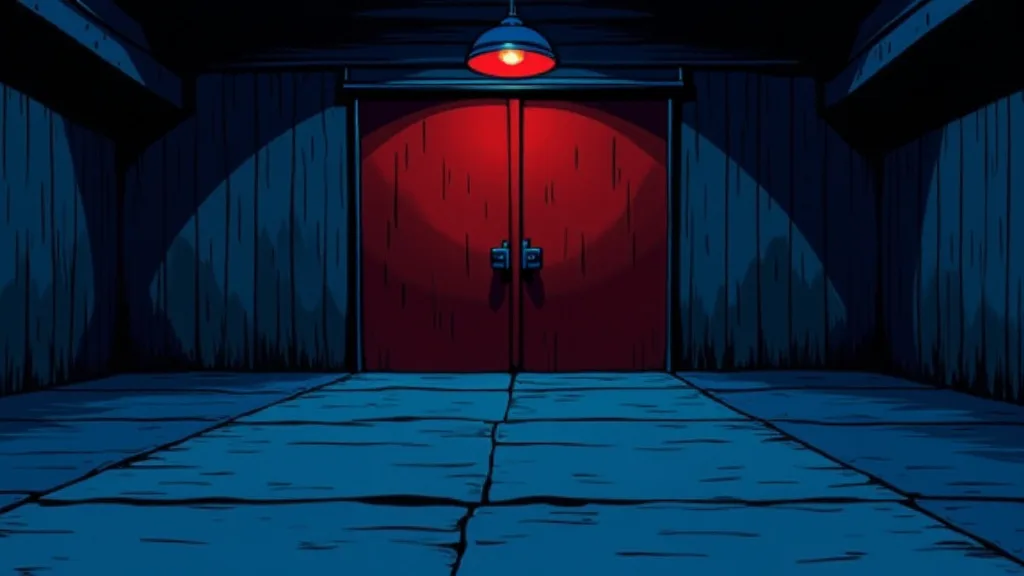
The door stays shut. Art: Team Zer0
How the machine earns its keep here: Niche of One Content Creator GPT Kit.
Comments are open to members. Sign up free →