How to Price Digital Products as a Creator
/How to price digital products without falling for premium-pricing myths: cheap, fair pricing that builds trust and volume, plus the floor, ceiling, and bundle ladder for when nobody knows you yet.
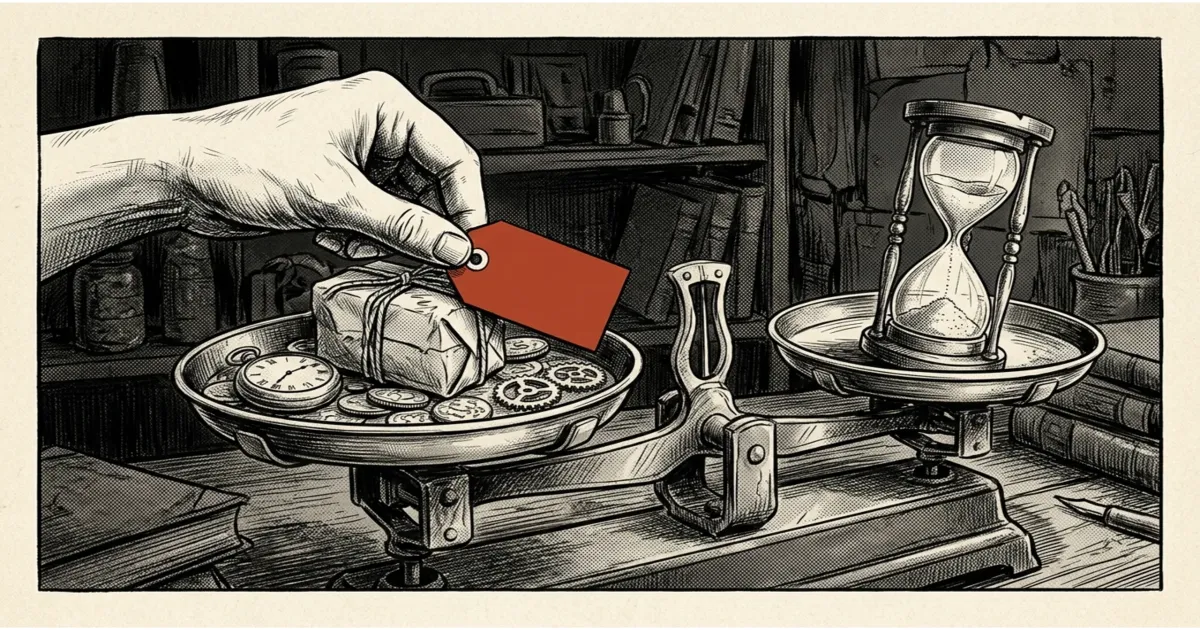
To price digital products, set a number that feels fair to the person buying, not a number meant to signal that you’re expensive. For most guides, templates, and PDFs that means $2 to $15, and for a paid newsletter or membership, $5 to $10 a month. A high price tag does not prove quality, it just narrows the door so fewer people walk through. Cheap, fair pricing reaches more buyers, builds trust faster, and stacks into real money across a catalog over time.
That answer goes against most creator advice you’ll read. The advice says charge premium, anchor high, never compete on price. This guide explains why that advice costs you the customers you never see turn around at the price tag, and gives you a system for pricing that actually works for a person selling a $5 PDF from a kitchen table.
Price does not equal quality
The most common line in creator circles is that price dictates perception of quality. Charge more, the thinking goes, and people assume your work is worth more.
It’s a half-truth dressed up as a law. A high price guarantees one thing only: fewer people get access. It does not guarantee the work is good. The $200 course and the $1,000 mastermind flooding your feed are not better because they cost more, they are just gated.
That gate sends a message to anyone who’s ever been broke: if you can’t afford to play, you don’t deserve to win. Plenty of creators grew up the kind of poor where you hope the lights stay on. They learned to buy on usefulness, not on the number on the sticker. If you price for the people who think like that, you build something the premium crowd can’t touch: reach.
Affordability is a strategy, not a weakness you tolerate until you “graduate” to premium. Lean tools, thin margins, profits rolled back into making the next thing. Done on purpose, cheap pricing turns a gatekept market into an open door.
How to price digital products: a working framework
Forget the abstract debates. Here’s how to put a number on the thing you made.
Match the price to the format, not your ego
A latte gets consumed once. A guide solves a problem the buyer keeps. Price the format for the job it does:
- One-page checklist: $1. A list that saves someone from forgetting something expensive is worth a dollar to almost anyone.
- Short guide (7 to 15 pages): $2 to $5. The person Googling a fix at midnight wants the answer, not a textbook.
- Template or spreadsheet: $3 to $10. People pay for structure they don’t have to build themselves.
- Field manual (30 to 50 pages): $9 to $15. Real depth on a thing you know cold.
- Bundle of three related products: the individual total minus 15 to 20 percent. New product, no new writing.
These are starting points, not commandments. The point is that the format tells you the range, and the range is lower than the gurus want you to believe.
Price for your goal, not an arbitrary standard
Pick what you actually want before you pick a number.
- Want reach and volume? Charge less and scale up. A $5 product that 5,000 people buy beats a $50 product that 50 people buy, and it builds you a far bigger audience to sell the next thing to.
- Want fewer clients who pay more? Charge premium and accept a smaller, higher-touch crowd.
Both work. Neither is automatically better. The mistake is letting someone else’s “premium or die” rule decide for you. Your expertise might be worth $500 an hour in consulting. Your newsletter is a different product serving a different need, and it can cost a fraction of that without insulting anybody.
Don’t price from fear
Most first prices are too low for the wrong reason and too high for the wrong reason at the same time. Too low because you don’t believe anyone will pay for something you made on a Tuesday afternoon. Too high because a guru told you cheap looks desperate.
Set the price you’d genuinely call fair if you were the buyer. Then leave it alone and go make the next product. The price isn’t the lever that makes or breaks you, the catalog is.
Pricing from zero: no audience, no reputation, no social proof
Everyone tells you to “charge what you’re worth.” That advice is useless when you’re nobody. Nobody knows what you’re worth. Neither do you. Here’s what actually works.
The floor: $4
Below $4, Gumroad’s fees eat too much of the transaction. Above $4, you’re competing with every other $5-$10 guide on the platform. At $4, you’re the impulse buy. Someone reads your thread, clicks through, sees $4, and thinks “cheaper than a coffee.” They don’t need to trust you yet, just to be curious.
To square that with the $1 and $2 price points in the framework above: those still have a job. The $4 floor is platform math, not a law of value.
A dollar checklist belongs inside a bundle, on a rail you own where the fees don’t bite, or out front as the handshake that brings a stranger in. Affordability is the strategy either way. The floor just keeps the fee collectors from being the only ones who get paid.
The ceiling: $29
That’s the ceiling for a single digital product from someone without a reputation. Above $29, people need social proof: testimonials, sales numbers, a name they recognize. Below $29, the decision is “do I want this?” not “do I trust this person?”
The sweet spot
$4-$9 for guides and templates. $14-$19 for bundles. $29 for a course or system.
My top seller is $4. It’s sold over 100 copies. At $4, that’s $400+ from one guide. At $9, I’d have sold half as many. The math on cheap products is better than you think.
The bundle ladder
Every $4 product should have a $14 bundle that includes it plus two related guides. Every bundle should point to the $29 system. This is the ladder: $4 gets them in the door, $14 keeps them, $29 turns them into a customer who’ll buy the next thing.
Free is a strategy, not a price
Some guides I give away free. A free guide that pulls somebody one step closer to owning their own operation is worth more to me than four dollars and a stranger I never hear from again. A guide that brings in 50 people who trust you beats a $4 one that sells 10 copies. Know which one you’re making before you set the price.
The full free-to-paid playbook, including when to paywall and when to hold the door open, is in Make & Sell Small Things.
Kill the “it’s just a latte” myth
There’s a specific piece of advice worth dragging into the light, because it traps a lot of people: “If you charge $5 a month, you’re telling subscribers your expertise is worth less than a fancy coffee.”
That’s lazy thinking. You’re not telling anyone your expertise is worth less than coffee, you’re telling them your subscription costs less than coffee. Those are different sentences.
The coffee comparison only works if you pretend a latte and a newsletter are the same kind of thing. They aren’t. The coffee is gone in twenty minutes. The newsletter shows up every week and keeps showing up. Comparing the two is a sales trick, and it’s pointed at you, not at your customer.
Here’s what a $5-a-month price actually signals:
- You care more about reach than squeezing revenue out of each subscriber.
- You want people who can’t swing $50 a month to still get in.
- You understand that an accessible price builds a bigger room.
The creators chasing “premium pricing” often end up with small, quiet communities. They optimized revenue per customer and forgot about total impact. A $5 newsletter with 50,000 subscribers clears around $250,000 a month. A $50 newsletter with 500 subscribers clears $25,000. Ask which of those creators has more influence, more security, and more options the next time they want to launch something.
So price against your goals, not against overpriced beverages. Your audience deserves better than coffee-shop economics.
Cheap pricing is the real flex
Charging little on purpose, when you could charge more, is a flex most creators are too scared to make. It reads as confidence, not weakness, because of what it does over time.
Affordable pricing builds trust
A low price lowers the risk of the first transaction. Someone risks $3 on a stranger’s PDF far more easily than $300 on a course. They buy, the thing actually delivers, and now they know you keep promises. That’s a customer you didn’t have to convince twice.
One friend left an agency job and made a seven-page PDF about organizing a home workshop. Priced it at three dollars. Sold eleven copies while he slept. Thirty-three bucks, less than his old lunch tab. But those eleven strangers found him on their own, decided the work was worth it, and paid him directly with no algorithm and no ad budget in between. Six months later he was clearing a thousand a month. The cheap first product was the handshake.
Cheap products are proof, not charity
A handful of small sales is not a failure to monetize, it’s proof of concept. Forty dollars in a month means real people exchanged real money for something you made, and that validation can’t be faked or bought. Those buyers now know you deliver. Next time you put something on the shelf, they pay attention.
You’re not selling yourself to anyone, you’re proving you’re worth buying into. Desperation smells through the sales page. Proof just sits there and compounds.
Cheap scales into a catalog
This is where the math the premium crowd ignores comes back around. One $2 product feels like nothing. But a catalog of thirty products at $2 to $15, moving at different speeds to different people across different months, is a business.
A shelf doesn’t need you awake. A guide written in March sells in November, and the eight months in between are free money. Some products sell two copies a week forever. Some sit dead for a month, then move three in a day because someone shared a link you’ll never trace. Below roughly fifteen products on the shelf, each one sits alone. Above that, the catalog starts feeding itself: a buyer finds one guide, sees four others, comes back next week, forwards a link to a friend with a different problem.
That’s the part nobody mentions about “passive” income. The word is a lie that hides a truth. It isn’t passive to build. But the work decouples from the revenue, so an hour spent building a product keeps paying long after the hour spent posting content has evaporated.
If you want to see what a working low-price catalog looks like in practice, the store is the whole model on display: small guides, fair prices, no funnel.
Common pricing mistakes to avoid
- Pricing high to look credible. Credibility comes from the work delivering, not from the number. A high price on a thin product just buys you refunds and bad reviews.
- Giving everything away forever. Free content trains your audience to expect free, and trains the platforms to sell ads against your attention. Your knowledge has a dollar value that doesn’t expire when the feed refreshes. Charge something.
- Waiting for the perfect big product. The small thing you could finish this weekend beats the comprehensive thing you’ve been planning for six months and haven’t started.
- Quitting at month three. Eleven dollars the first month, forty the second, two hundred the third. People dig up the tree to check the roots and wonder why nothing grew.
- Letting one platform own you. Spread across formats and shelves so no single fee hike or algorithm change can wipe you out.
For tools, hosting, and the gear that keeps a lean operation lean, the recommended shops cover what’s actually in use, not whatever pays the highest affiliate cut.
Frequently asked questions
How much should I charge for a PDF or digital guide?
For a short guide of seven to fifteen pages, $2 to $5 is the working range. A one-page checklist runs about $1, a template $3 to $10, and a deeper 30-to-50-page field manual $9 to $15. Price for the format and the problem it solves, not for what makes you look expensive. Cheap and fair sells more copies and builds you repeat buyers.
Does a higher price make my product look higher quality?
No. A higher price guarantees fewer people can access your work, nothing more. Quality comes from whether the product actually solves the buyer’s problem. Plenty of $200 courses are worse than a $5 guide. Let the work prove its value instead of leaning on the price tag to imply it.
What should I charge for a paid newsletter or subscription?
$5 to $10 a month works for most creators who want reach. A $5 newsletter that reaches 50,000 people earns far more, and builds a bigger audience, than a $50 one that reaches 500. Ignore the “your subscription is just a latte” line. Your subscription costing less than coffee is a feature, not an insult to your expertise.
Is cheap pricing bad for my brand?
The opposite. A low, fair price lowers the risk of the first sale, so more strangers take a chance on you. When the product delivers, you’ve earned a customer who trusts you and comes back. Affordability reads as confidence and builds the volume and loyalty that premium pricing usually can’t.
What should I charge if nobody knows who I am?
Start at a $4 floor and treat $29 as the ceiling. Below $4, Gumroad’s fees eat too much of the transaction. Above $29, a buyer needs testimonials, sales numbers, or a name they recognize before they’ll say yes. In between, the decision is “do I want this?” not “do I trust this person?”, and a $4-$9 guide is the easiest first sale because it’s an impulse buy that only asks for curiosity.
How do I make real money selling $2 to $5 products?
Build a catalog. A single cheap product is a brick; thirty of them moving at different speeds across different months is a wall. Around fifteen products in, the catalog starts feeding itself as buyers find one thing and discover the rest. The revenue comes from the aggregate stocking up over time, not from one product going viral. For format ideas and a steady stream of what’s working, the newsstand is a good place to start.
Related guides
Pricing is one decision in a chain that starts with making the product and ends with getting it in front of buyers.
- Make & Sell Small Things: Products, Pricing, Offers, and Affiliates That Actually Pay
- How to Sell Digital Products on Gumroad
- How to Self-Publish Without Permission
- How to Build an Audience That Cares
The rest of the field guides cover the chain end to end.
Comments are open to members. Sign up free →