What $25 and a Double-Click Gets You
/Desk of One is ten boards, a Summary that does the arithmetic on your own numbers, and five AI jobs that read your rows and write from them. One file, works offline, source included.

TL;DR: Desk of One is the operations desk for a one-person publishing shop. Ten boards, a Summary that tells you what an hour of your work actually earned, and five AI jobs that read your own rows and write from them. One HTML file you double-click. Twenty-five dollars, once, source included.
Double-click the file.
It opens in your browser. That was the install.
No account to make. No email to hand over. No plan to pick.
There’s a row waiting for you and you start typing into it, which is the point, because the gap between deciding to track something and actually tracking something is where most of this dies.
Ten boards, and every one has a job.
- Daily Writing. What you wrote, who for, words, minutes, done or not.
- Newsletter. One row per issue, with the link, because a back issue nobody can find is a back issue nobody reads.
- Articles. Everything you publish somewhere that isn’t yours, with a Points home? column.
- Social. The post and the response. There’s a column called People who asked how.
- Affiliates. What you applied to, what came back, what you’ll actually put your name on.
- Products. One row per thing you sell. The last column is Kill number (write it first).
- Feedback. What buyers said, in their words, not your summary of their words.
- Money. In, out, platform fee in its own column, Net computed for you.
- Tools. What you pay for whether you open it or not, with a Verdict column.
- Time. Hours against the work.
That People who asked how column tells you what to build next better than any dashboard I’ve paid for. And the Kill number is the one people skip and then regret. You write it before you start, while you’re not tired and not attached, and six months later the decision is already made.
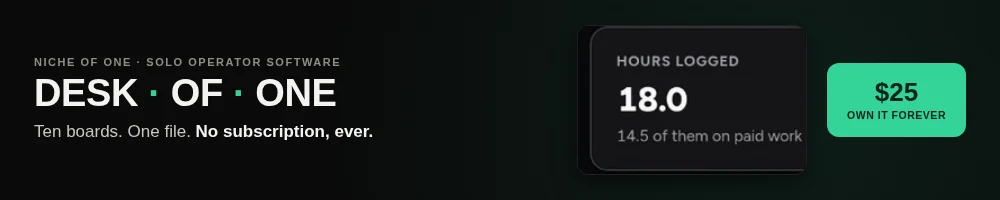
The Summary does the arithmetic.
It reads Money, Tools and Time and puts six numbers up.
Came in, after platform fees. Went out. Tools per month. Tools per year, which is the number nobody adds up on purpose. Hours logged.
And then an hour of yours. What you earned, divided by the hours you actually logged.
No benchmark. No industry average. Nobody to compare yourself against. It’s your money over your time, and the first time you see it you’ll either feel good or start making changes.
There are no targets anywhere in this file. No goal lines, no streaks, nothing that turns red at midnight. It counts what you put in and stops.
Five AI jobs, on your own account.
Connect a key from Anthropic, Google or OpenRouter and the AI tab wakes up. Your key, your account, billed to you at cost, usually a fraction of a penny a run. Nothing goes anywhere until you press a button.
- Turn my writing into posts. Everything marked Done gets three short posts.
- What should I cancel? Reads Tools, argues for killing things, cheapest win first, yearly saving on each.
- What do buyers keep asking for? Groups Feedback into themes and names the next thing to make.
- Subject lines for my next issue. Eight, off the Newsletter board.
- Write my weekly review. Reads every board and tells you what shipped, what stalled, where the money came from and where the hours went.
That last one is why I built the tab. Sunday night, one button, and the week comes back as sentences instead of a wall of rows.
Bring your old spreadsheet across.
Import takes any CSV, whatever the columns are called. A sales export, a bank statement, the eight tabs you’ve been limping along with.
A panel opens showing every column of the board, what it reckons belongs in each one, and the first row of your file right beside it, so you see where everything lands before it moves. Change what’s wrong, then import. One undo takes the whole thing back off.
If the names match nothing at all, your AI can work the mapping out. It only ever answers with column positions, never with your data, so it can’t invent a row or change a value.
It’s a file. That’s the best part.
Everything lives in your browser, on your machine. Turn the wifi off and every board still works, because the boards were never talking to anything.
Back up everything writes one JSON file you keep. Import reads it back on any machine.
The whole source ships inside the download, MIT licensed. Open it in a text editor and the boards are a plain list near the top. Add a column. Rename one. Add a whole board. Build something better out of it and sell that, commercially, without asking me. Keep my name on it somewhere findable and we’re square.
Twenty-five dollars, one time. An 8-page guide in the download and the same guide inside the app. There’s a 45-second walkthrough on the page, so watch it work before you spend anything.
If you bought the two-dollar Side-Hustle Megasheet, this is already sitting in your library. Nothing to claim.
Let me know what you think of it.
~ J.D.
Comments are open to members. Sign up free →