What My Swipe File Looks Like
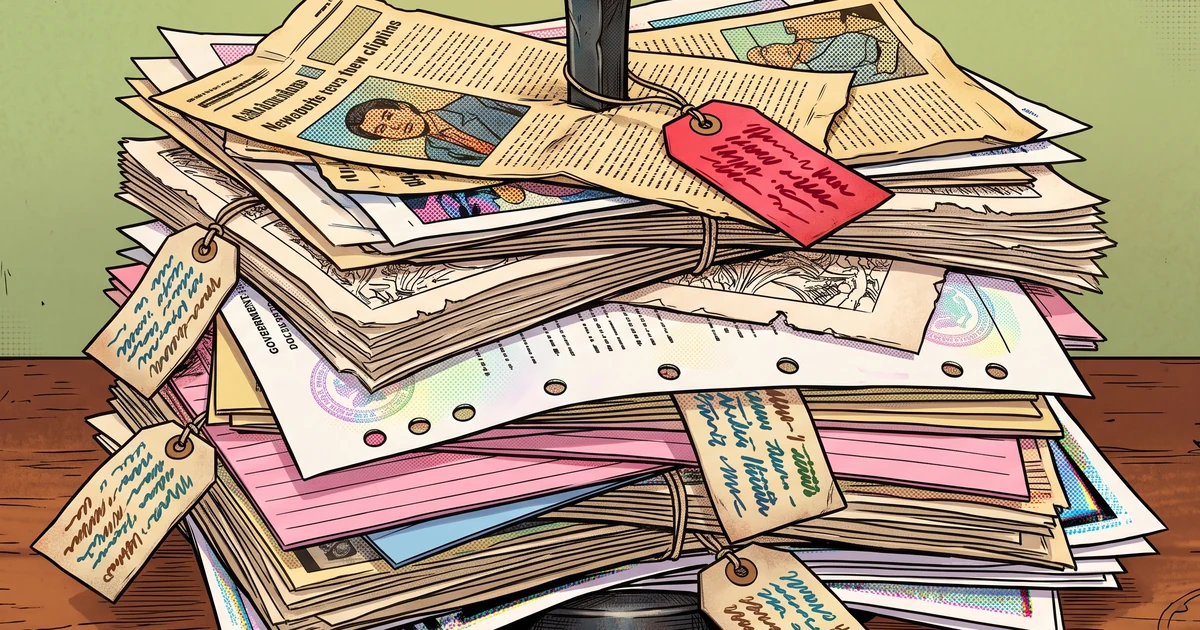
/A pile of quotes, government PDFs, book fragments, headlines, and mechanisms, each saved by function, kept with its provenance, and robbed for parts later.
TL;DR: I file source material by the job it can do later, instead of the subject it came from. Provenance is the only rule that keeps the pile honest.
Right now the file holds a declassified Army memo about altered consciousness, seventy-five Medium earnings lines, a 1730 exposure of Masonic ritual, notes about chicken livers used as fake tumors, half a dozen headlines that almost work, and a Content card telling me which folder I buried the source in.
The polished version of a swipe file is bullshit staged for a photograph, beige index cards and a fountain pen lying diagonally across the corner of a walnut desk. Mine reads like an evidence locker after a shelving accident.
I went through all seventy-five of those earnings lines in one sitting, other people’s months laid out in a column, most of them under a dollar and a few of them flat zero, every one of them typed out by somebody who figured the number was gonna come out bigger than that. It didn’t.
I kept the whole column because that shape argues harder than any essay I could write about the platform. That’s why I can’t leave the file alone. Damn near everything I’ve published started as somebody else’s scrap I couldn’t put down.
Everything in there is doing a job
Some of it I keep for rhythm alone, one sentence that moves the way I want a paragraph of mine to move someday.
A story gets in on the mechanism buried under it, the part I can lift out and set down in a field it was never built for. Numbers do puncture work. A claim that has been getting away with being general runs into one and dies.
Contradictions can hold an entire essay by themselves. The CIA hosts a document it did not write. Twenty-four people were called witches and twenty-one of them denied it, and Masonic secrets survived by becoming public.
I save structures too. How the writer got in, where the evidence showed up, which question bent the piece sideways, what got withheld until the last paragraph.
“Good quote” is a worthless note. In six months it tells me nothing except that I had taste once. Future me needs to know why I dragged the body home.
Every item needs a route back and a route forward
Raw material lands wherever it lands. Notes, research sweeps, source folders, PDF dumps, exports, project files nobody named on purpose.
The Master Content Backlog collects findings with an application attached to each one. The Content board turns some of them into assignments. A draft folder takes the ones with enough evidence to survive contact with prose.
Taxonomy ain’t what rescues any of that. The route does, and a route has two ends, back to where the thing came from and forward to a piece it might feed.
Tags help when they describe future use. “Occult” names a subject and does nothing else for me.
“Manufactured proof” names a mechanism, and that one tag ties Jim Jones to online testimonials to rented experts to a staged demonstration on a corporate stage. The second kind of tag makes more work and pays for it, which is the same bargain I made when I started using AI as a drafting tool instead of a writing replacement.
I save the pressure under the sentence
If a headline lands on me, I write down what’s doing the pushing: a withheld subject, an ugly number, a confession, a document sitting in an archive that has no business holding it. Then I build that same pressure around my own material. If I save a paragraph, I mark the movement running underneath it, because the sentences aren’t portable and the movement is.
Source details stay attached, always. Exact language gets quotation marks and a name.
Facts keep links or local file paths. My own experience stays mine.
A swipe file without provenance is a plagiarism machine with folders on it, and the poor bastard running one is fucked the day somebody else’s sentence turns up in his paragraph with his byline sitting under it and no record anywhere of where he got it. Keep the receipts.
Distance forces transformation. Pulling two sources out of unrelated domains means neither one survives the trip intact, which is the point of the exercise.
A prepper’s rotation system will fix a content inventory. A 1730 Masonic exposure explains why leaked information doesn’t kill an institution, which reads different next to anything about building so you can leave. The bridge changes both sides.
Most of what I save is attic
Collecting feels like progress and never asks you to publish a damn thing, so the folder grows and the drafts don’t. The cure is application. Every research finding carries at least one possible use written down beside it, even a bad one, and every active card names its source.
Deletion belongs in the system too. A quote with no provenance goes, and a headline with no mechanism goes. An idea that produces nothing but generic advice goes, because generic advice is the exact product ten thousand people are already giving away free to build a mailing list, and I’d rather spend that hour on the smallest thing that sells.
Storage is cheap. Attention rents by the hour and the landlord doesn’t take payment plans.
The file starts working when old fragments call across folders without being asked. One note supplies the fact. Another supplies the frame, and a failed draft from a year back supplies the opening it never deserved the first time.
I left the three unidentified PDFs where they were, in a folder named misc, wearing whatever filenames the download gave them.
Sources
- Austin Kleon: Steal Like an Artist
- Austin Kleon: Show Your Work!
- Joe Forrest’s Notes archive, Master Content Backlog, and Rook Content board
Frequently asked questions
What is a swipe file?
A personal collection of examples, language, structures, and source material kept for study and later use.
Should a swipe file contain full copied articles?
Usually no. Save the part you need, keep the source with it, and write down why it matters. Copyright and platform rules apply to a private folder the same as to a published page.
How should swipe-file entries be tagged?
Subject tags help you find things again. Functional tags such as mechanism, structure, contradiction, or evidence help you connect things that were never filed together.
Comments are open to members. Sign up free →