The Fake Image Fails at the Seams
/AI-image detection now depends on physics, object connections, text, source tracing, and provenance. Six fingers are only the loudest bad brushwork.
TL;DR: AI images still betray themselves through broken shadows, impossible focus, fused edges, nonsense connections, and damaged text. Those clues keep getting weaker. Source history and signed provenance deserve more trust than a confident squint at somebody’s fingers.
The sixth finger gets all the press.
It is big, vulgar, easy to circle in red. Meanwhile the hospital tube runs into a pillow and stops. Three shadows point toward three private suns.
The lettering on an official seal has all the confidence of a drunk sign painter working from memory.
That is not an insult I am borrowing. I have painted signs my whole working life and it is the tell.
A drunk sign painter and a diffusion model make the identical mistake: both are drawing the shape of letters instead of writing. You see it in the spacing before you can read the word. Decades of laying out marquee copy by hand, one ink, one halftone, one red, and the thing my eye lands on has never once been the fingers.
Jack Izzo’s Snopes guide to spotting AI images collects the visual seams their fact-checkers inspect. The guide keeps the right warning close: one odd detail does not prove generation, and models keep getting better at yesterday’s mistakes.
Light, depth of field and broken connections still give it away
Useful clues include inconsistent light, impossible depth of field, malformed extremities, broken object connections, repeated patterns, and text that almost survives inspection.
Start where two systems have to agree. A hand gripping a glass requires anatomy, perspective, transparency, and contact. A medical tube crossing a blanket needs a continuous path through wrinkles and shadow. An earring has to attach to an ear that belongs to a head under hair.
Generators can render each object beautifully and lose the handshake between them. That is why seams matter more than isolated weirdness. Follow wires.
Count chair legs. Check whether eyeglass arms reach the ears or evaporate into skin.
Light provides another cross-check. Nearby shadows under one sun should share a direction, though flash, windows, reflectors, and several light sources can complicate the scene. Depth of field should also match lens behavior.
A subject and distant background both razor-sharp may be possible, but the capture method needs to make sense.
The eye is collecting questions, not delivering a verdict.
Why are hands and garbled text weaker evidence now?
Hands and text remain worth checking, but newer models produce both with enough accuracy that their absence proves nothing.
Snopes cites a fake image of a hospitalized Mitch McConnell where the fingers looked plausible. Tubes and wires exposed the fabrication by ending or looping without purpose. In other examples, the useful text errors had shrunk to punctuation, capitalization, letter shape, and a Costco logo whose C became a G.
Model improvement moves the failure from the poster to the fine print. A giant nonsense word has become less common. The surviving defect may sit inside a state seal or on a sign nobody expects a viewer to enlarge.
Human photographs contain oddities too. Compression smears fingers. Panoramic stitching duplicates people.
Portrait mode guesses wrong around hair. A cheap phone uses computational blur that would have looked synthetic ten years ago because half of modern photography is a small machine arguing with the lens.
Detection by vibes fails hardest on unusual art direction. Flat spot color, halftone fields, collage edges, and intentional distortion can resemble generated errors to somebody trained only on naturalistic photography. A style choice deserves provenance, not an accusation dressed as eyesight.
Verify the source, the earlier copies, the credentials
Verify the source, search for earlier copies, inspect available metadata, and look for signed content credentials or platform-specific generation markers.
Reverse image search can reveal an older publication, a different caption, or the human photograph used as raw material. Trace the account that posted it. A screenshot from an unnamed friend is a lead with its coat turned up, not evidence.
A goose photo shot two counties over helped burn down a town’s reputation in 2024, and no model touched it. The chain doesn’t need to be synthetic to be a lie.
Provenance beats pixel divination when the chain survives. The C2PA specification defines signed manifests that can record origin and every edit after it. TikTok has tagged more than a billion videos with that history, and YouTube, Meta, and LinkedIn now surface it to anyone who checks.
Other providers watermark instead of signing. Google’s SynthID has been baked into Gemini’s images since 2025, and OpenAI started checking for it through a public verification tool this past May. When Snopes ran the McConnell fake through it, the watermark confirmed what the looping tubes already implied.
None of these systems is universal. Cropping, screenshots, re-encoding, and hostile editing can strip or break provenance. Missing credentials do not prove an image is human-made.
Present credentials can show what a signer asserted and whether the record was altered after signing.
Context finishes the job. Did the event happen? Do local outlets show the same scene?
Does the weather match? Are the uniforms, signs, and architecture from the claimed place? A synthetic image can be visually flawless and historically impossible by lunchtime.
What should an art desk do before using a suspicious image?
An art desk should stop the asset, preserve the original file and URL, document checks, and require independent confirmation before publication.
Do not edit the suspected file first. Save the original hash and metadata where possible. Capture the post, account, date, and caption.
Run reverse searches on the full image and distinctive crops. Ask the source for the original capture and surrounding frames.
The decision record matters when the visual test is inconclusive. Write down why the desk accepted or rejected the asset. “Looked fake” will rot under scrutiny. “No earlier copy, broken tube geometry, inconsistent signage, and the named hospital confirmed the event did not occur” can be audited.
Art directors also need a separate policy for generated illustration. Label it. Keep the prompt and source assets.
Check for accidental logos, faces, and visual claims. A clearly synthetic spot illustration does different work than a counterfeit news photograph.
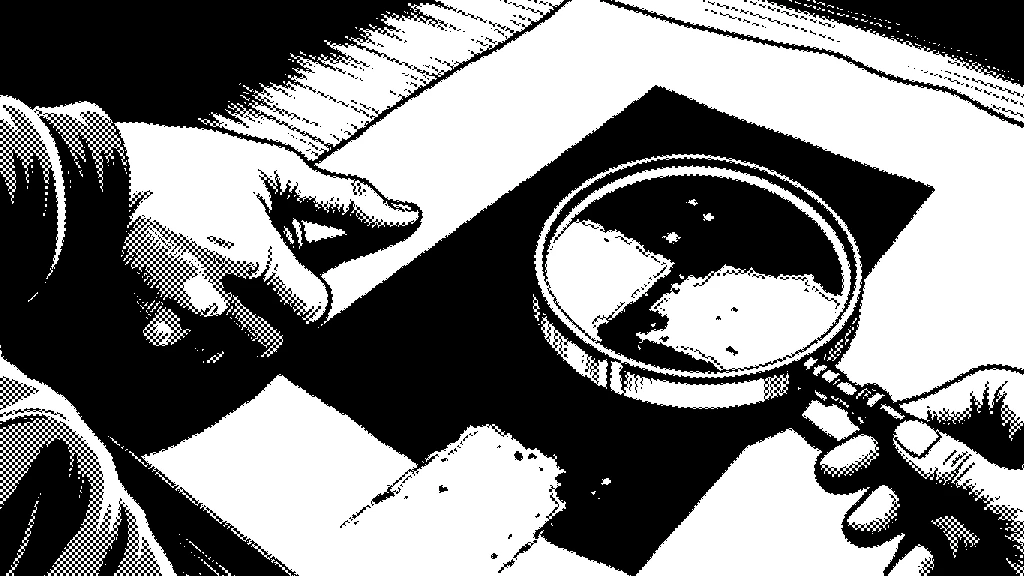
Under magnification, the red circle waits around a finger. The better clue is three inches away, where the wedding ring has fused to a champagne flute and neither object casts the shadow it owes the table.
Frequently asked questions
Do extra fingers prove an image was made by AI?
No. Extra or malformed fingers are a clue, while editing artifacts, panoramic stitching, motion, and medical conditions can also create unusual anatomy. Verify the source and other evidence.
Can AI-image detectors give a final answer?
No detector is reliable across every model, edit, and compression path. Treat a detector score as one signal among source tracing, visual inspection, metadata, and corroboration.
What are Content Credentials?
Content Credentials are a way to display cryptographically signed provenance information based on C2PA standards, such as who created or edited an asset and which tools were involved.
Comments are open to members. Sign up free →